Melasma Treatment
Expert Melasma Treatment in San Diego
Looking for melasma treatment in San Diego? KIAMO SKIN is a licensed corrective skin studio in Mission Hills, specializing in safe, effective treatment for hormonal pigmentation across all skin tones—with advanced expertise in melanin-rich skin.
Melasma is notoriously stubborn because it's hormonally driven. It requires a carefully paced series of treatments combined with daily sun protection—not one aggressive session. At KIAMO, we treat melasma with chemical peels formulated for deeper skin tones, microchanneling (which works without heat), and customized corrective facials. Learn more about our full approach to corrective skin treatments.
Understanding melasma
What is melasma?
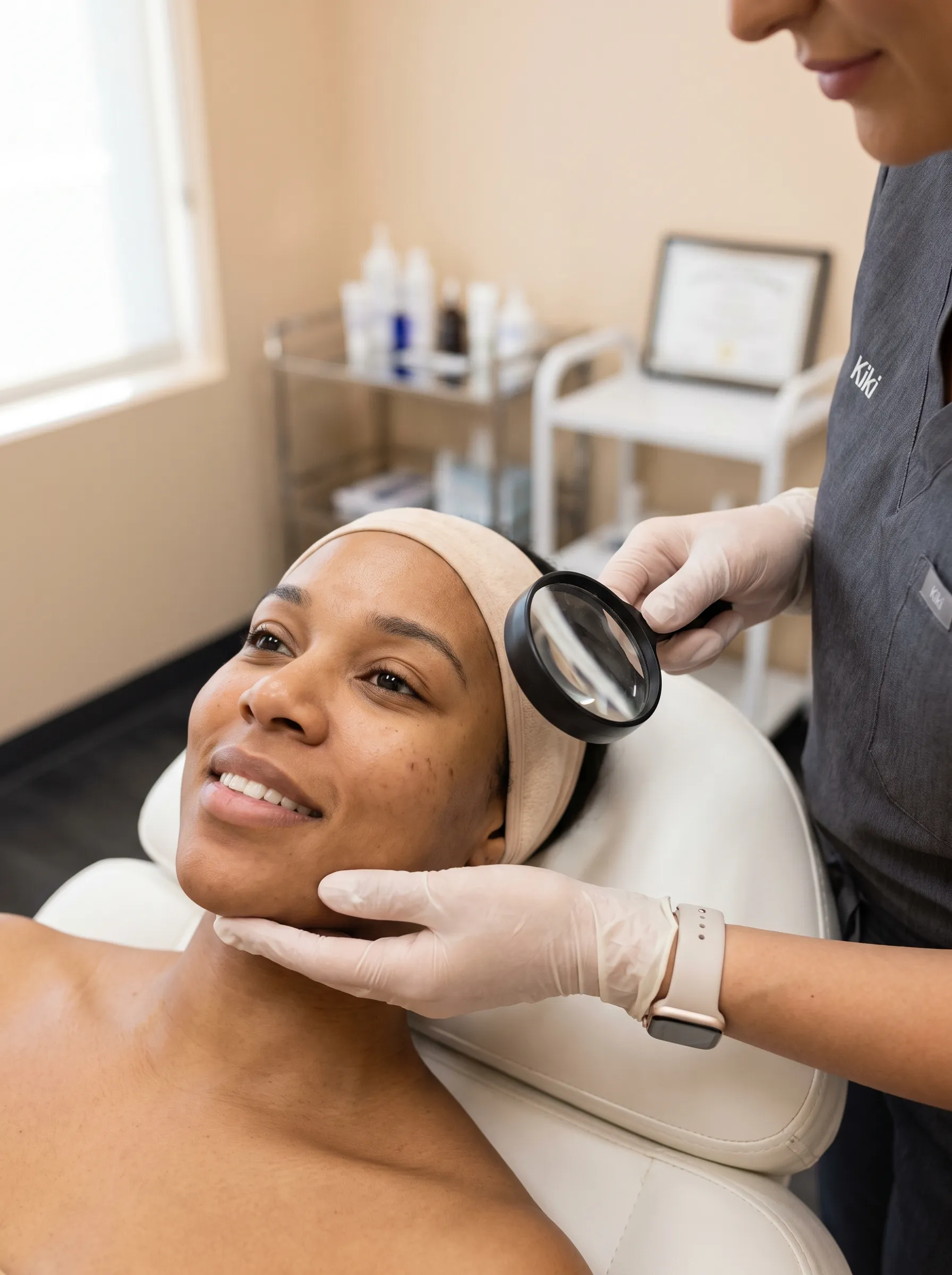
Melasma is a type of hyperpigmentation that appears as brown or gray-brown patches on the face—most commonly on the cheeks, forehead, bridge of the nose, and upper lip. Unlike acne marks or age spots, melasma is triggered by hormonal changes, sun exposure, and heat.
It's most common in women with darker skin tones, and it's often called the "pregnancy mask" because pregnancy hormones are a frequent trigger. Birth control, menopause, and certain medications can also cause it. What makes melasma so frustrating is that it doesn't respond to typical brightening serums alone—it requires professional treatment combined with strict daily sun protection.
Treatment approach
How we treat melasma in San Diego
Melasma treatment at KIAMO is never one-size-fits-all. We use a combination of professional treatments selected for your skin tone, pigmentation depth, and how your skin responds. Every plan is paced across a series—strength escalates gradually rather than aggressively in one visit.
LIRA Chemical Peels
Professional-grade peels formulated for melasma and pigmentation. Strength escalates across a series rather than in one aggressive visit.
$199–$299
Learn moreProcell Microchanneling
Stimulates collagen and reduces pigmentation without heat or light—safe for melanin-rich skin where heat can trigger more pigment.
$475
Learn moreHydraFacial with Brightening Booster
Customized HydraFacial with targeted brightening serums to maintain results between deeper corrective treatments.
$259
Learn more
The challenge
Why melasma is harder to treat than other pigmentation
Melasma isn't just a surface issue—it's driven by hormones, which means it's constantly being triggered from within. Sun exposure, heat, and even stress can make it worse. That's why aggressive treatments that work for acne marks or sun spots often backfire on melasma—they can actually trigger more pigment instead of fading it.
This is especially true for melanin-rich skin, where the risk of post-inflammatory hyperpigmentation (PIH) is higher. One wrong move—too strong a peel, incorrect settings, heat-based treatments—and you end up with more pigmentation, not less.
That's why melasma treatment at KIAMO is always escalated gradually. We start with prep, then build strength across a series as your skin tolerates it. Every treatment is customized for your skin tone, and we never use heat-based modalities on deeper skin—microchanneling works mechanically, without the heat that triggers pigment.
Prevention
Common melasma triggers to avoid in San Diego
Even with professional treatment, melasma will return if the triggers aren't managed. Here's what to watch for:
- •Hormonal changes (pregnancy, birth control, menopause)
- •Sun exposure and UV damage
- •Heat exposure (including hot yoga and saunas)
- •Certain medications and skincare ingredients
- •Santa Ana wind events (dry desert heat, October–January) that destabilise even previously controlled pigmentation
- •The May Gray / June Gloom marine layer — overcast mornings still pass UV 8–10 through the cloud cover, and skipping it is the most common reason San Diego clients regress mid-treatment
- •Hard-water mineral film (San Diego municipal water runs 280–320 ppm calcium and magnesium), which disrupts barrier function and worsens the inflammatory backdrop melasma lives in
Daily broad-spectrum SPF 30 or higher is non-negotiable. In San Diego, where sun exposure is year-round—even on overcast days—skipping SPF means your melasma will darken and any treatment progress will reverse. We recommend mineral sunscreens with iron oxides, which block both UV and visible light (another pigment trigger).
Expertise
Why melanin-rich skin expertise matters for melasma
Melasma is most common in deeper skin tones, and treating it safely requires advanced training. Here's why:
Melanin-rich skin produces pigment more readily in response to trauma, heat, and inflammation. That means treatments that are "safe" for lighter skin can cause post-inflammatory hyperpigmentation (PIH) in darker skin—leaving you with moredark marks instead of fewer.
Kiki's expertise was built treating the most complex pigmentation cases: melanin-rich skin, where the margin for error is smallest. That training means she knows how to pace treatments, which acids are safe, which boosters to avoid, and when to escalate strength versus when to hold steady. It's the reason clients with any skin tone trust KIAMO for melasma—because training on the hardest cases makes you the safest choice for everyone.
Learn more about pigmentation treatment for melanin-rich skin
What to expect: timeline and cost
Melasma treatment is a commitment, not a quick fix. Here's what a typical plan looks like:
- Home prep (2–4 weeks): Most clients begin with a home care routine to prepare the skin before professional treatments start. This primes the skin to respond and helps minimize the risk of irritation or rebound pigmentation.
- Treatment series (6–8 sessions): Professional treatments are spaced 4–6 weeks apart. Most clients begin to see improvement after 3–4 sessions, with cumulative results building across the series.
- Maintenance (ongoing): Once melasma is under control, maintenance treatments (typically monthly or quarterly) prevent recurrence. Daily SPF and home care are essential to hold results.
Cost: Because melasma requires a series, many clients use amonthly facial membership ($199/month) to make ongoing treatment more affordable. Membership treatments can be applied toward peels, microchanneling, or HydraFacials, making it the most cost-effective way to stay consistent.
Common questions
Frequently asked questions about melasma treatment
What is melasma?
How is melasma different from other types of hyperpigmentation?
Can melasma be permanently cured?
What melasma treatments are safe for melanin-rich skin?
How many treatments does it take to see results?
Why is sun protection so important for melasma?
Do you treat melasma on all skin tones?
How much does melasma treatment cost?
Where can I get melasma treatment in San Diego?
Why is melasma harder to treat in San Diego?
Can pregnancy melasma be treated in San Diego?
How far do clients travel for melasma treatment at KIAMO?
What should I avoid in San Diego if I have melasma?
Should I see an esthetician or dermatologist for hyperpigmentation?
How do I find an esthetician experienced with dark skin?
What causes post-inflammatory hyperpigmentation?
What is the best facial for melasma in San Diego?
Ready to start treating your melasma?
Every melasma treatment plan starts with a consultation to assess your skin, pigmentation depth, and treatment history. From there, we'll build a customized plan paced for your skin tone and goals.
The menu
Corrective treatments in Mission Hills, San Diego
Facials in San Diego
The umbrella-category guide to every facial modality offered at KIAMO Skin — HydraFacial, Lira chemical peels, DMK enzyme therapy, and dermaplaning — each calibrated to every Fitzpatrick skin type.
First-Time Client Treatment
The best place to begin. Includes a comprehensive consultation, skin analysis, customized HydraFacial, personalized booster, microcurrent, LED Light Therapy, Hydrojelly Mask, and a long term treatment plan.
HydraFacial Treatment
A customized HydraFacial that deeply cleanses, exfoliates, extracts, and hydrates to support healthy skin and maintain your treatment results.
Dermaplane Facial
A surgical blade lifts away dead surface cells and fine facial hair, with extractions as needed. Minimal downtime.
DMK Level 1 Enzyme Treatment
Foundational enzyme therapy. Works with the skin's own processes to clear what should not be there and rebuild the barrier.
LIRA Gentle Renewal Peel
A light peel selected for your skin on the day — acne, congestion, uneven texture, dullness or a compromised barrier.
Keravive Scalp Treatment
Medical-grade scalp treatment for dryness, flaking, and scalp health. Unlike relaxation head spas, Keravive uses clinical-grade exfoliation and hydration to address scalp concerns at the source.
Keravive Scalp — 3 Treatment Series
The same treatment across a series of three, priced as a package. Scalp work is cumulative rather than one-off.
Procell Microchanneling
Microchanneling treatment for acne scars, hyperpigmentation, and texture—safe for all skin tones. Uses controlled micro-injury and growth factors to resurface skin and correct post-inflammatory pigmentation.
Procell Microchanneling — 3 Treatment Series
Designed for clients committed to long-term correction. A series of three treatments supports progressive collagen remodeling and is recommended for concerns such as acne scars, uneven texture, fine lines, and overall skin rejuvenation. Treatments are typically scheduled 4–6 weeks apart.
DMK Level 2 & 3 Enzyme Treatment
Layered Enzyme 1, 2 and 3 with corrective products. Prescribed only once Level 1 has prepared the skin.
Pricing at consultation.
Book DMK Level 2 & 3 Enzyme TreatmentLIRA Advanced Peel
A deeper chemical peel for pigmentation and acne scarring, with strength escalated across a series rather than in one visit. Safe for melanin-rich skin.