Hyperpigmentation Treatment
Hyperpigmentation Treatment by KIAMO SKIN
Hyperpigmentation can be one of the most frustrating skin concerns because it often remains visible long after the original breakout, irritation, or inflammation has passed. Dark marks, uneven tone, melasma, and post-inflammatory pigmentation can all make the complexion look less even, even when the skin itself feels healthy.
KIAMO SKIN approaches hyperpigmentation as a concern that deserves more than a one-size-fits-all treatment. The right approach depends on what is contributing to the discoloration, the current condition of the skin, and how well the skin can tolerate corrective treatments.
Authority
A Corrective Approach to Hyperpigmentation
Effective pigmentation care starts with understanding that not all hyperpigmentation is the same.
Dark marks following acne can behave differently from melasma. Pigmentation associated with inflammation may require a different strategy from generalized uneven tone. Skin that is already irritated or experiencing barrier disruption may also need a different starting point than skin that is stable and able to tolerate more intensive corrective treatments.
KIAMO SKIN's corrective skincare philosophy considers these differences when determining an appropriate treatment direction. This is especially relevant for melanin-rich skin, where pigmentation is often a significant concern and treatment selection requires careful consideration.
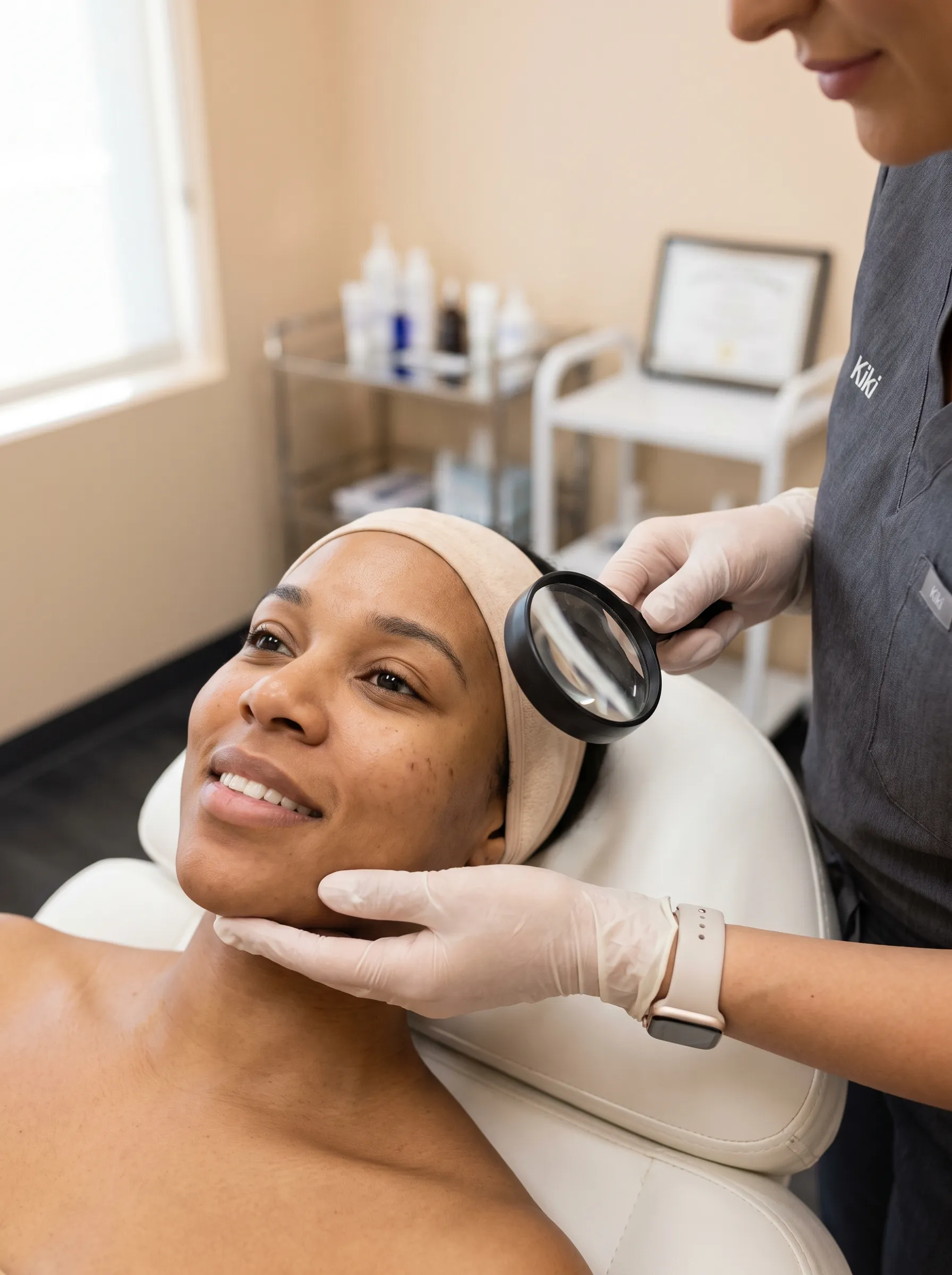
Understanding the concern
What Hyperpigmentation Concerns Can Treatment Address?
Rather than approaching discoloration as an isolated surface issue, corrective skincare looks at the broader condition of the skin and the factors contributing to its appearance.
Hyperpigmentation treatment may be appropriate for concerns including:
- •Dark marks left after acne or inflammation
- •Uneven skin tone
- •Post-inflammatory hyperpigmentation
- •Persistent discoloration
- •Melasma-related pigmentation
- •Dull or uneven-looking complexion
- •Visible contrast between areas of more and less pigmentation
The purpose is not simply to make pigmentation disappear as quickly as possible. A thoughtful corrective plan considers how the skin is behaving now and what approach is appropriate for its current condition.
Uniqueness
Hyperpigmentation Care for Melanin-Rich Skin
Pigmentation is a particularly important consideration for people with melanin-rich skin. When the skin responds to acne, irritation, inflammation, or other triggers by producing additional pigment, the resulting marks can remain visible long after the original concern has improved.
That means a treatment plan needs to consider more than the pigment itself.
KIAMO SKIN's focus on melanin-rich skin is an important part of its corrective skincare identity. Treatment selection can take into account the appearance of pigmentation, the overall condition of the skin, and whether the skin is currently experiencing sensitivity, congestion, dryness, or barrier concerns.
This approach also helps avoid one of the most common mistakes in pigmentation care: assuming that stronger treatment automatically means better treatment.
Depth
How Does Hyperpigmentation Treatment Work?
There is no universal hyperpigmentation protocol because the appropriate treatment depends on the individual's skin and the nature of the concern.
A professional treatment strategy can generally involve several stages:
1. Identify the pigmentation concern
The first step is understanding what you are trying to improve. Is it post-acne discoloration? Persistent dark marks? Uneven tone? Melasma? Or a combination of concerns? Identifying the dominant concern helps determine which treatment options may make sense.
2. Evaluate the condition of the skin
Pigmentation does not exist independently from the rest of the skin. Dehydration, congestion, irritation, acne, and barrier disruption can all influence how the skin looks and how it may respond to treatment.
3. Select an appropriate corrective treatment
Depending on the skin and treatment goal, options may include chemical peels, Procell Microchanneling, HydraFacial, Dermaplaning, or DMK Enzyme Therapy. The appropriate option should be determined according to the individual's skin rather than selected solely because a particular treatment is currently popular.
4. Build consistency
Pigmentation concerns can take time to address. A treatment plan may involve a series of professional treatments alongside appropriate home care and attention to factors that can contribute to recurring discoloration.
Treatment options
Professional Treatment Options
Depending on the individual and the concern, professional options may include:
Lira Chemical Peels
Professionally selected exfoliation may be considered when uneven tone and texture are part of the concern.
Learn moreProcell Microchanneling
May be considered when pigmentation exists alongside concerns such as uneven texture or the appearance of acne scarring.
Learn moreHydraFacial
Can provide cleansing, exfoliation, extraction, and hydration as part of a broader skincare strategy.
Learn moreDermaplaning
Provides physical exfoliation and can help create a smoother-feeling skin surface when appropriate.
Learn moreDMK Enzyme Therapy
Takes a different approach centered on the overall condition and function of the skin.
Learn more
Intent
Who Is Hyperpigmentation Treatment For?
Hyperpigmentation treatment may be worth exploring if you feel that dark marks or uneven tone are not improving with your current skincare routine.
You may be looking for professional guidance if:
- Acne has improved but dark marks remain
- Your complexion looks uneven even when your skin feels healthy
- You experience recurring pigmentation after breakouts or irritation
- You have concerns about melasma
- You have tried multiple products without a clear strategy
- You are unsure which professional treatment is appropriate
- You want a corrective skincare plan rather than a routine facial
One important distinction is that treating pigmentation is not always the same as treating the cause of the pigmentation. For example, if active acne continues to create inflammation, addressing acne may be an important part of reducing the cycle of new post-inflammatory marks.
Optimization
Building a Complete Corrective Skincare Strategy
Hyperpigmentation can overlap with several other skin concerns, which makes internal treatment planning especially important.
For example, someone dealing with post-acne dark marks may benefit from a strategy that considers both acne and pigmentation. Someone concerned about pigmentation and texture may have different treatment priorities from someone whose primary issue is dehydration or barrier disruption.
Related KIAMO SKIN services can therefore support different parts of a broader corrective strategy:
- Acne Treatment for concerns involving breakouts and congestion
- Melasma for persistent pigmentation concerns associated with melasma
- Procell Microchanneling for treatment considerations involving texture and the appearance of acne scarring
- Lira Chemical Peels for professional exfoliation
- HydraFacial for cleansing, exfoliation, extraction, and hydration
- DMK Enzyme Therapy for a treatment approach focused on overall skin condition
- Dermaplaning for physical exfoliation and a smoother-feeling surface
- Melanin-Rich Skin to learn more about KIAMO SKIN's specialized approach
Browse hyperpigmentation treatment by San Diego neighborhood
The objective is not to stack treatments unnecessarily. It is to understand which concerns are connected and determine which treatment sequence makes sense for the skin.
Common questions
Frequently Asked Questions
What is the best treatment for hyperpigmentation?
Can hyperpigmentation from acne be treated?
Is hyperpigmentation treatment suitable for melanin-rich skin?
How long does hyperpigmentation treatment take to work?
Should I treat acne or hyperpigmentation first?
What causes post-inflammatory hyperpigmentation?
How do I find an esthetician experienced with dark skin in San Diego?
Should I see an esthetician or dermatologist for hyperpigmentation?
Why is hyperpigmentation harder to treat in San Diego?
Can I treat hyperpigmentation at home or do I need professional treatments?
Take the Next Step With KIAMO SKIN
If dark marks, uneven tone, or persistent pigmentation are making you feel frustrated with your skin, you do not have to keep guessing which treatment to try next.
KIAMO SKIN's corrective approach starts with understanding the concern and the condition of your skin, then selecting an appropriate treatment strategy. When you're ready to move from trial and error toward a more intentional corrective skincare approach, contact KIAMO SKIN to discuss your skin concerns and next steps.
The menu
Corrective treatments in Mission Hills, San Diego
Facials in San Diego
The umbrella-category guide to every facial modality offered at KIAMO Skin — HydraFacial, Lira chemical peels, DMK enzyme therapy, and dermaplaning — each calibrated to every Fitzpatrick skin type.
First-Time Client Treatment
The best place to begin. Includes a comprehensive consultation, skin analysis, customized HydraFacial, personalized booster, microcurrent, LED Light Therapy, Hydrojelly Mask, and a long term treatment plan.
HydraFacial Treatment
A customized HydraFacial that deeply cleanses, exfoliates, extracts, and hydrates to support healthy skin and maintain your treatment results.
Dermaplane Facial
A surgical blade lifts away dead surface cells and fine facial hair, with extractions as needed. Minimal downtime.
DMK Level 1 Enzyme Treatment
Foundational enzyme therapy. Works with the skin's own processes to clear what should not be there and rebuild the barrier.
LIRA Gentle Renewal Peel
A light peel selected for your skin on the day — acne, congestion, uneven texture, dullness or a compromised barrier.
Keravive Scalp Treatment
Medical-grade scalp treatment for dryness, flaking, and scalp health. Unlike relaxation head spas, Keravive uses clinical-grade exfoliation and hydration to address scalp concerns at the source.
Keravive Scalp — 3 Treatment Series
The same treatment across a series of three, priced as a package. Scalp work is cumulative rather than one-off.
Procell Microchanneling
Microchanneling treatment for acne scars, hyperpigmentation, and texture—safe for all skin tones. Uses controlled micro-injury and growth factors to resurface skin and correct post-inflammatory pigmentation.
Procell Microchanneling — 3 Treatment Series
Designed for clients committed to long-term correction. A series of three treatments supports progressive collagen remodeling and is recommended for concerns such as acne scars, uneven texture, fine lines, and overall skin rejuvenation. Treatments are typically scheduled 4–6 weeks apart.
DMK Level 2 & 3 Enzyme Treatment
Layered Enzyme 1, 2 and 3 with corrective products. Prescribed only once Level 1 has prepared the skin.
Pricing at consultation.
Book DMK Level 2 & 3 Enzyme TreatmentLIRA Advanced Peel
A deeper chemical peel for pigmentation and acne scarring, with strength escalated across a series rather than in one visit. Safe for melanin-rich skin.