12 min read · Field notes from the treatment room
Professional Scalp Treatment San Diego: Keravive for Dandruff, Flaking & Hair Health
Professional scalp treatment in San Diego. Keravive for dandruff, seborrheic dermatitis, dry scalp and thinning, treating the cause rather than the symptom.
First-time client treatment
$249
- By appointment only
- Free parking
- Free cancellation up to 48 hours before
Rated 5 out of 5 stars. — 42 five-star Google reviews
- Written by Kiki, licensed esthetician
- Last updated August 20, 2026
- 42 five-star Google reviews
- Prices published before a booking is made
Over-the-counter shampoos treat surface symptoms. Professional Keravive scalp therapy at KIAMO Skin addresses the root cause: buildup, congestion, and inflammation below the surface that at-home products simply can't reach.
Why San Diego residents need professional scalp treatment
San Diego's environment creates unique scalp challenges that over-the-counter products can't fully address. Hard water, year-round sun exposure, ocean salt, and dry inland climate all contribute to scalp issues that require professional intervention.
Living in San Diego means your scalp deals with conditions that accelerate buildup and inflammation:
- Some of California's hardest water. San Diego's tap water contains high levels of calcium and magnesium that deposit on your scalp with every shower, creating a layer of mineral buildup that traps oils, clogs follicles, and mimics dandruff. Medicated shampoos can't dissolve these deposits.
- Year-round UV exposure. San Diego averages 266 sunny days per year. Chronic sun exposure on your scalp triggers inflammation and accelerates cell turnover, leading to increased flaking and sensitivity.
- Ocean and beach lifestyle. Salt spray from the coast (even inland areas like North Park), chlorine from pools, and sand particles all contribute to scalp congestion. For residents in Pacific Beach, La Jolla, and Del Mar, this is a daily reality.
- Dry inland climate. Areas like Mission Valley, North Park, and Carlsbad experience low humidity, which causes scalp dryness that's often mistaken for dandruff. Moisturizing shampoos provide temporary relief but don't restore the scalp barrier.
These environmental factors combine to create scalp issues that standard products can't fix. Professional scalp treatment removes years of accumulated buildup in a single session--something no at-home routine can achieve.
If you live in San Diego, there's an additional factor making your dandruff worse--and most dermatologists never mention it.
What causes dandruff?
Dandruff is caused by a combination of oil production, a yeast called Malassezia, and how quickly your scalp sheds dead skin cells. Malassezia lives on everyone's scalp, but some people's immune systems react to it, triggering inflammation and rapid cell turnover that shows up as visible flakes. In San Diego, hard water mineral buildup can make the problem worse by creating additional scalp irritation that mimics or compounds dandruff symptoms.
That's why dandruff isn't just about dryness. You can have an oily scalp and still see flakes.
That's why dandruff often gets worse in winter or during periods of high stress--your scalp's inflammatory response intensifies, and cell turnover speeds up even more.
At KIAMO Skin in San Diego, we see this constantly: clients come in after trying every shampoo at CVS, only to discover their scalp was covered in hard water buildup, not dandruff.
How do I know if my dandruff is fungal or dry scalp?
Fungal dandruff (seborrheic dermatitis) shows as greasy, yellowish flakes with redness and often intense itching, while dry scalp produces small, white flakes without much oil. If moisturizing makes it worse or anti-dandruff shampoo doesn't help after 2 weeks, you're likely dealing with seborrheic dermatitis rather than simple dryness.
Here's how to tell them apart:
- Dry scalp: Small, white flakes that fall easily. Scalp feels tight or itchy, especially after washing. Moisturizing helps. Often worse in winter or low-humidity environments.
- Fungal dandruff: Larger, greasy flakes that stick to hair. Scalp looks red or inflamed. Itching is persistent. Flakes may have a yellowish tint. Worsens with oil or heavy conditioners.
If you're seeing flaking in multiple zones, it's not dry scalp. It's an inflammatory condition that requires a different treatment approach.
If it only improves with hydration and gets worse with medicated shampoos, it's dryness.
What kills dandruff quickly?
Over-the-counter shampoos with zinc pyrithione, ketoconazole, selenium sulfide, or salicylic acid can reduce visible flakes within 1-2 weeks when used correctly. The key is leaving the lather on your scalp for 5 minutes before rinsing, not just washing and rinsing immediately--most people skip this step and wonder why nothing works.
But they all require contact time. If you apply the shampoo, scrub, and rinse in under a minute, the active ingredients never penetrate the scalp.
Here's the process that actually works:
- Wet your hair thoroughly. Hard water in San Diego means you need more time and heat to open the cuticle and let active ingredients in.
- Apply medicated shampoo directly to your scalp, not your hair. Massage it into the skin in circular motions.
- Leave it on for 5 minutes. Set a timer. This is when the active ingredients work.
- Rinse completely. Residue left behind can cause more irritation.
- Repeat 2-3 times per week until flakes clear, then reduce to once or twice weekly for maintenance.
If one active ingredient stops working after a few months, switch to a shampoo with a different mechanism--your scalp can adapt to a single treatment, but rotating between two types keeps it effective.
What are the best at-home dandruff treatments?
| Active Ingredient | What It Does | Best For | How to Use | Examples |
|---|---|---|---|---|
| Zinc Pyrithione | Reduces yeast and bacteria on the scalp | Mild to moderate dandruff, all hair types | 2-3x per week, leave on 3-5 minutes | Head & Shoulders, Dove DermaCare |
| Ketoconazole 1-2% | Antifungal; targets <em>Malassezia</em> directly | Severe dandruff, seborrheic dermatitis | 2x per week, leave on 5 minutes | Nizoral A-D |
| Selenium Sulfide | Slows scalp cell turnover, fights yeast | Stubborn dandruff, oily scalp | 2x per week, leave on 5 minutes, rinse thoroughly | Selsun Blue |
| Salicylic Acid | Exfoliates and removes crusty scale buildup | Thick, crusty flakes; scalp psoriasis | 2-3x per week, may cause dryness--follow with conditioner | Neutrogena T/Sal |
| Coal Tar | Slows cell turnover, reduces inflammation | Scalp psoriasis, very thick dandruff | 1-2x per week, strong smell, can darken light hair | Neutrogena T/Gel |
Rotation strategy: If your dandruff improves then comes back after a few months, alternate between two different active ingredients--for example, zinc pyrithione on Monday and Thursday, ketoconazole on Sunday. This prevents your scalp from adapting to one treatment.
Apply the medicated treatment only to your scalp, let it sit, then rinse. Follow with a moisturizing conditioner on your hair strands, avoiding the scalp.
Why do I still have dandruff even after washing my hair?
If you're washing daily and still see flakes, you're either not using a medicated shampoo, not leaving it on long enough, or dealing with a condition that mimics dandruff like seborrheic dermatitis or psoriasis. San Diego's hard water can also leave mineral deposits that look like flakes even when dandruff is controlled.
That buildup prevents medicated shampoo from reaching your actual scalp, which is why the flakes never fully go away.
Other reasons shampoo stops working:
- You're not treating the cause. Regular shampoo removes surface flakes but doesn't address the yeast, oil, or inflammation causing them. You need a medicated formula with an active ingredient.
- Product buildup is blocking treatment. Dry shampoo, styling gels, leave-in conditioners, and even silicone-heavy shampoos create a layer on your scalp that traps oil and dead skin. Medicated shampoo can't penetrate that barrier.
- You're actually dealing with seborrheic dermatitis or psoriasis. These are inflammatory scalp conditions that require prescription treatment or professional care. Over-the-counter shampoo helps, but it won't fully clear the problem.
- Your scalp pH is off. Hard water raises scalp pH, which makes it easier for Malassezia to thrive. An apple cider vinegar rinse (1 part vinegar to 4 parts water) can help rebalance it--but won't remove mineral buildup already there.
If you've been using medicated shampoo correctly for 4 weeks and still see flakes, it's time to escalate.
What is commonly mistaken for dandruff?
Seborrheic dermatitis, scalp psoriasis, eczema, and product buildup all produce flakes that look like dandruff but don't respond to typical dandruff shampoos. If you also have flaking eyebrows, behind your ears, or along your hairline, you're likely dealing with seborrheic dermatitis rather than simple dandruff.
| Condition | What It Looks Like | Where It Shows Up | How It Feels |
|---|---|---|---|
| Dandruff | White or light yellow flakes, loose and dry | Scalp only | Mild itching, worse when hair is oily |
| Seborrheic Dermatitis | Greasy, yellowish flakes; red, inflamed skin | Scalp, eyebrows, sides of nose, behind ears, chest | Intense itching, burning, or stinging |
| Scalp Psoriasis | Thick, silvery scales; well-defined red patches | Scalp (often at hairline), elbows, knees | Tight, sore, sometimes bleeding when scratched |
| Scalp Eczema | Dry, cracked skin; flakes mixed with oozing or crusting | Scalp, neck, behind ears | Severe itching, worsens with scratching |
| Product Buildup | White flakes that feel waxy or sticky | Scalp, especially near part lines | Scalp feels heavy or greasy even after washing |
Over-the-counter ketoconazole shampoo often helps, but prescription treatments may be needed.
If you're seeing thick, adherent scales that don't budge with regular shampooing, or if your scalp is painful or bleeding, see a dermatologist. These are signs of psoriasis or eczema, not dandruff.
When should I see a professional for dandruff?
See a dermatologist or licensed esthetician if over-the-counter treatments haven't worked after 4 weeks, if your scalp is severely inflamed or painful, or if you're losing hair along with the flaking. Professional scalp treatments can remove the buildup that shampoo can't reach.
Here's when to escalate:
- Medicated shampoo didn't work after a month of correct use. If you've been leaving zinc pyrithione or ketoconazole on your scalp for 5 minutes, 2-3 times per week, for 4 weeks, and you still see flakes, the problem is deeper than what shampoo can fix.
- Your scalp is red, swollen, or painful. This suggests seborrheic dermatitis, psoriasis, or a secondary infection. You need a professional diagnosis.
- You're losing more hair than usual. Chronic scalp inflammation can weaken hair follicles and increase shedding. Treating the scalp condition can help slow hair loss.
- Flaking comes with intense itching that disrupts your sleep or daily life. This is a quality-of-life issue that deserves professional intervention.
- You've tried multiple active ingredients and nothing holds. Your scalp may have become resistant to over-the-counter treatments.
Clients from La Jolla to Carlsbad come in after their dermatologist prescribed medicated shampoo that didn't solve the underlying scalp congestion. Once the buildup is cleared, medicated shampoo actually works again.
What is professional scalp treatment for dandruff?
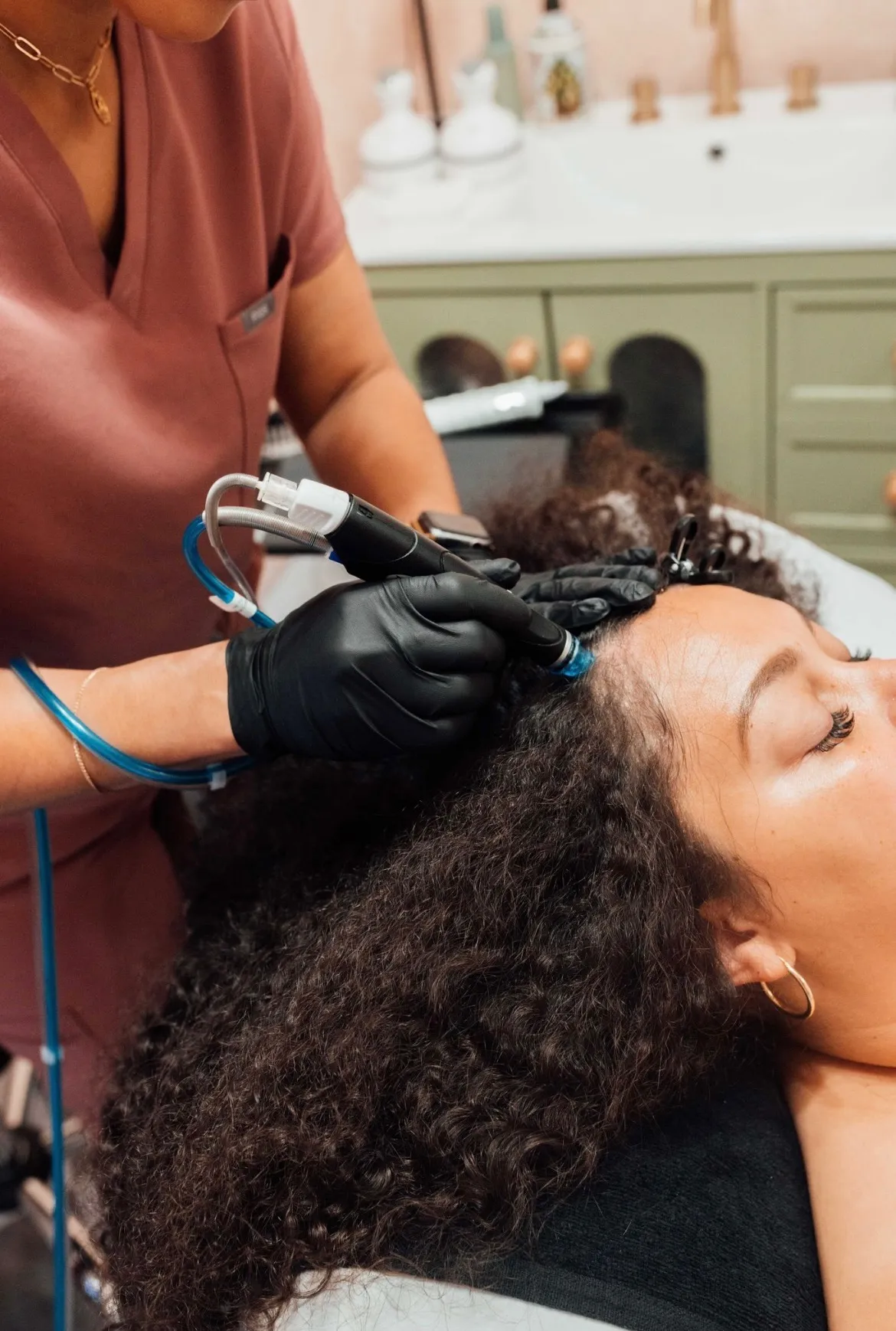
Professional scalp therapy uses clinical-grade exfoliation and hydration to address the root cause--clogged follicles, oil imbalance, and chronic inflammation--rather than just treating surface flakes. HydraFacial Keravive is a 3-step process that cleanses, exfoliates, and infuses peptides into the scalp, similar to how a HydraFacial works on facial skin.
Step 1: Cleanse
This isn't a massage or a scrub--it's vacuum extraction. The device physically lifts out congestion that's been sitting there for months.
That's calcium, magnesium, styling product, sebum, and dead skin--all layered together in a way that shampoo can't touch.
Step 2: Nourish
A concentrated peptide complex is infused into the scalp to support a healthier environment for healthy hair growth. The peptides help calm inflammation, improve circulation, and nourish the follicles.
The peptide serum goes directly into clean follicles, not onto a layer of residue.
Step 3: Continue at home
Consistency is what holds the result--one deep cleanse clears the congestion, but regular maintenance keeps it from coming back.
Pricing at KIAMO Skin:
- Single Keravive Scalp Treatment: $599
- 3-Treatment Series: $1,499 (recommended for chronic buildup or inflammatory scalp conditions)
Who benefits from Keravive?
- Chronic dandruff that doesn't respond to medicated shampoo. If you've tried zinc pyrithione, ketoconazole, and selenium sulfide with no improvement, buildup is likely blocking the active ingredients from reaching your scalp.
- San Diego residents dealing with hard water damage. If your scalp feels tight, itchy, or flaky even after shampooing, mineral deposits are likely the problem.
- Anyone who invests in skincare but has never treated their scalp. Your scalp is skin. If you're getting monthly facials but ignoring your scalp, you're missing a major source of congestion and inflammation.
- People experiencing increased shedding with visible scalp buildup. A congested scalp creates a poor environment for healthy hair growth.
Tara K., who drives in from Del Mar, said: "Made the trip from Del Mar after race season and my skin texture was completely different by the third Procell session. The scalp work was the surprise bonus."
Bree A., from Carlsbad, added: "Coming from Carlsbad I blocked off the whole morning. We did Procell and Keravive back-to-back and it made every long drive worthwhile."
Keravive isn't a luxury scalp spa treatment--it's corrective therapy for a scalp that standard products can't fix. Book a Keravive consultation at KIAMO Skin in San Diego.
What happens if dandruff is left untreated?
Chronic dandruff can lead to persistent scalp inflammation, increased hair shedding, and secondary infections from constant scratching. While dandruff itself doesn't cause permanent hair loss, the inflammation and scratching it triggers can weaken hair follicles over time.
Here's what happens when dandruff goes unaddressed:
- Inflammation becomes chronic. The longer Malassezia colonizes your scalp, the more your immune system reacts. Chronic inflammation disrupts the hair growth cycle, pushing more follicles into the shedding phase prematurely.
- Scratching damages the scalp barrier. Constant scratching breaks the skin, creating entry points for bacteria. This can lead to folliculitis (infected hair follicles) or impetigo (a bacterial skin infection).
- Buildup thickens and hardens. Over months or years, oil, dead skin, and product residue form a dense layer on the scalp. This layer suffocates follicles, worsens itching, and makes the scalp harder to treat.
- Hair quality declines. A congested, inflamed scalp produces weaker hair. Strands may feel thinner, break more easily, or grow more slowly.
Dandruff won't make you bald, but it creates an environment where hair struggles. Treating it early--whether with medicated shampoo or professional scalp therapy--prevents the problem from escalating into something harder to reverse.
Where this leaves a client
A first visit is $249 and includes the consultation and skin analysis that turns any of this into a plan for the skin.
Prices are published, the studio is appointment-only, and parking is free.
Written by Kiki, Licensed Esthetician, California Board of Barbering & Cosmetology, with 7+ years treating melanin-rich skin at KIAMO Skin in San Diego.
Common questions
Dandruff Treatment Questions
Is it better to wash hair daily if I have dandruff?
Should you brush dandruff off?
Can dandruff be cured permanently?
Does San Diego water make dandruff worse?
Rated 5 out of 5 stars. — 42 five-star Google reviews
“I've been going to KIAMO Skin for over a year and can't recommend it enough. Real, visible results.”
Also in the journal
Three kinds of dark mark, and why one facial cannot fix all three
Choosing a facial for hyperpigmentation before you know which kind you have is the most common reason treatment fails — and occasionally the reason it backfires.
June gloom is not sun protection
The marine layer is the single most expensive misunderstanding in San Diego skincare. It looks like cover. It is not cover.
San Diego hard water and your scalp
If your scalp flakes, itches, or feels coated no matter what shampoo you buy, the shampoo may not be the variable worth changing.
Microneedling on dark skin, and why depth decides the outcome
Not whether needling works on melanin-rich skin, but whether the depth was set correctly for the skin in front of the device.
Is dermaplaning safe for dark skin? Here is what actually matters.
The question is not really whether dermaplaning works on darker skin. It is whether the blade angle and pressure match the skin in front of it.
San Diego Scalp Treatments: How Does Keravive Work?
Keravive removes the buildup shampoo cannot reach. Here is what it does, and why San Diego water and sun make it necessary.
Hyperpigmentation Treatment Guide: What Actually Works for Dark Spots, Melasma & PIH
Stubborn dark spots, melasma or uneven tone in San Diego: what actually helps, and why it depends on your skin type.
How much does a chemical peel cost in San Diego?
The price of a chemical peel in San Diego varies by depth and formulation. The more important question is which one your skin needs.
Best chemical peel for melasma, and what the answer actually depends on
Best peel for melasma is a search query, not a clinical answer. Here is the peel your skin type can tolerate every four to six weeks.
Acne scars in San Diego: which ones a facial can fix and which need microneedling
Most of the time when a facial "didn't work" for acne scarring, the scar type was never the issue. The treatment was.
Dermaplaning or a chemical peel: which one actually changes your skin?
These two sound like competing versions of the same thing. One removes what is on top; the other changes what happens underneath.
Best sunscreen for dark spots in San Diego: what to look for on the label
Most sunscreen in San Diego is bought on brand and worn on habit. For a mark that keeps returning, the label matters more than the name.
Chemical peel or microchanneling: which one will clear your dark spots
These two work in opposite directions, one down from the surface and one up from beneath. Choosing wrongly can leave a mark darker.
Best treatment for dark spots on face: which one clears yours, and what each costs
Dark spots have different causes and sit at different depths, so the best treatment only makes sense once you know which one is yours.
Facial for sensitive skin: which modality suits a reactive barrier, and what each one costs
Sensitive skin is not a skin type, it is a condition — and the treatment that calms it can be the treatment that makes it worse.
How much does a facial cost in San Diego in 2026?
The published San Diego market rate for a facial spans a wide range. The gap between the two ends of it is not quality. It is what the price includes. First-time clients here start at $249.
How to fade dark spots at home, and the three things that make them darker
Most home routines for dark marks fail in the same three places, and none of them is the product. The order, the light protection, and what happens in the week after a spot clears.
How to prepare for a chemical peel, and the week before that does the most work
A peel is the treatment, but the week before it is what decides how the skin responds to it. On melanin-rich skin that difference is the difference between clearing pigment and making more of it.
How to get the most out of a HydraFacial, including what to do the day before
A HydraFacial is a maintenance treatment with a specific job. Doing the day before it right is a short list, and the routine between visits is what decides whether it holds.