8 min read · Field notes from the treatment room
How to fade dark spots at home, and the three things that make them darker
Most home routines for dark marks fail in the same three places, and none of them is the product. The order, the light protection, and what happens in the week after a spot clears.
First-time client treatment
$249
- By appointment only
- Free parking
- Free cancellation up to 48 hours before
Dark spots fade at home when three things line up: a daily sunscreen with iron oxides for visible light, an active applied every day rather than occasionally, and patience measured in months rather than weeks. The habits that set marks back are scratching, picking, and skipping sunscreen on the days the sky looks flat.
Rated 5 out of 5 stars. — 42 five-star Google reviews
- Written by Kiki, licensed esthetician
- Last updated November 21, 2026
- 42 five-star Google reviews
- Prices published before a booking is made
The reason most home routines for dark marks fail is that they start in the wrong place. A brightening serum is opened, and the sunscreen is a thing that gets reapplied when there is a beach in the plan.
That order is backwards for San Diego, where the UV index sits in the very high band for most of the year and the overcast mornings are exactly when people skip it. The marine layer does not block UV. It hides the evidence of it.
There is a version of this that works at home, and it is worth spelling out precisely — not because the studio does not do the work in the room, but because what happens between visits decides what the room can work with.
What a dark mark actually is
A dark mark is melanin the skin produced in response to inflammation. The injury sets the pigment off and the pigment stays long after the injury has gone, which is why the mark outlives the spot by months. Three different conditions make marks — post-inflammatory marks, melasma and sun damage — and each one responds to a different part of the routine.
The distinction matters at home, because the first two are driven by what is happening to the skin right now, and the third is driven by what has been happening to it for years. The way to tell them apart is covered in which kind of dark mark you have, and it is worth reading before spending anything.
| Kind | What drives it | What fades it |
|---|---|---|
| Post-inflammatory | A spot, an injury, an ingrown hair, a nick while shaving | Ending the inflammation, then protecting the skin while it clears |
| Melasma | Hormonal change, sustained by UV and heat | A paced series of gentle peels, plus daily visible-light protection |
| Sun damage | Years of cumulative exposure | A series, plus daily protection — and the longest timeline of the three |
The order that works
Sunscreen first, active second, moisturiser third. Not because the sunscreen fades the mark, but because an active applied to unprotected skin is working in the wrong direction.
A retinoid, an azelaic acid and a vitamin C are a reasonable home set. All three have evidence behind them for pigment; all three can irritate skin that is already reactive; and using all three at once is how a barrier gets disrupted, which produces inflammation, which produces more pigment. One at a time, at the lowest strength that does something, is not timidity. It is how the mark is not made worse.
Azelaic acid is the one worth naming for melanin-rich skin specifically: it is well tolerated on deeper tones and addresses both the pigment and the inflammation that keeps producing more of it.
The sunscreen that matters in this county
For a mark that keeps coming back, the number on the bottle matters less than the presence of iron oxides. Visible light is a large part of what keeps melasma and post-inflammatory marks active, and iron oxides are what block it.
A tinted sunscreen carries them. A white or clear mineral sunscreen may not — and mineral filters are exactly the ones people reach for when a mark is flaring, because of the cast. The cast is the reason a lot of people give up on the one product that would have helped.
The way to read a label is covered in the best sunscreen for dark spots, and the two-hour reapplication rule is in the guide below.
What to do in the week after a spot clears
This is the window that gets missed. A spot has been inflamed for days; it clears; and the mark appears in its place. The instinct at that point is to attack it — with the spot treatment, with the scrub, with the extractor, with a needle.
Every one of those is a fresh injury, and every fresh injury starts the cycle again. The mark that would have faded in eight weeks becomes a mark that fades in a year.
What works instead is the least dramatic option: leave it alone, protect it, and keep the routine going. It is genuinely harder than treating it.
How long a mark takes at home
Weeks for a recent mark that stopped being irritated. Months for a post-inflammatory mark. A year or more for sun damage, and a series is usually what it takes.
The point worth making is that this timeline is the same one the studio works to. A peel series is not a shortcut around the biology; it is the same biology with more control over the pace, and with the inflammation managed rather than avoided.
If the mark has not shifted in eight weeks of a consistent routine, something else is holding it in place — usually the sunscreen, usually on the days the sky looks flat.
At the studio, the same work is done with a plan built around the kind of mark — peels or microchanneling, paced rather than escalated, with the home routine prescribed so the two halves of the plan agree with each other.
When a home routine is the wrong answer
Some marks are not a routine problem. A mark that is getting darker rather than flatter, a mark that is raised or textured, a mark that appeared alongside a change in the skin itself, or a patch that is genuinely irregular in shape and colour — those want an assessment, not a serum.
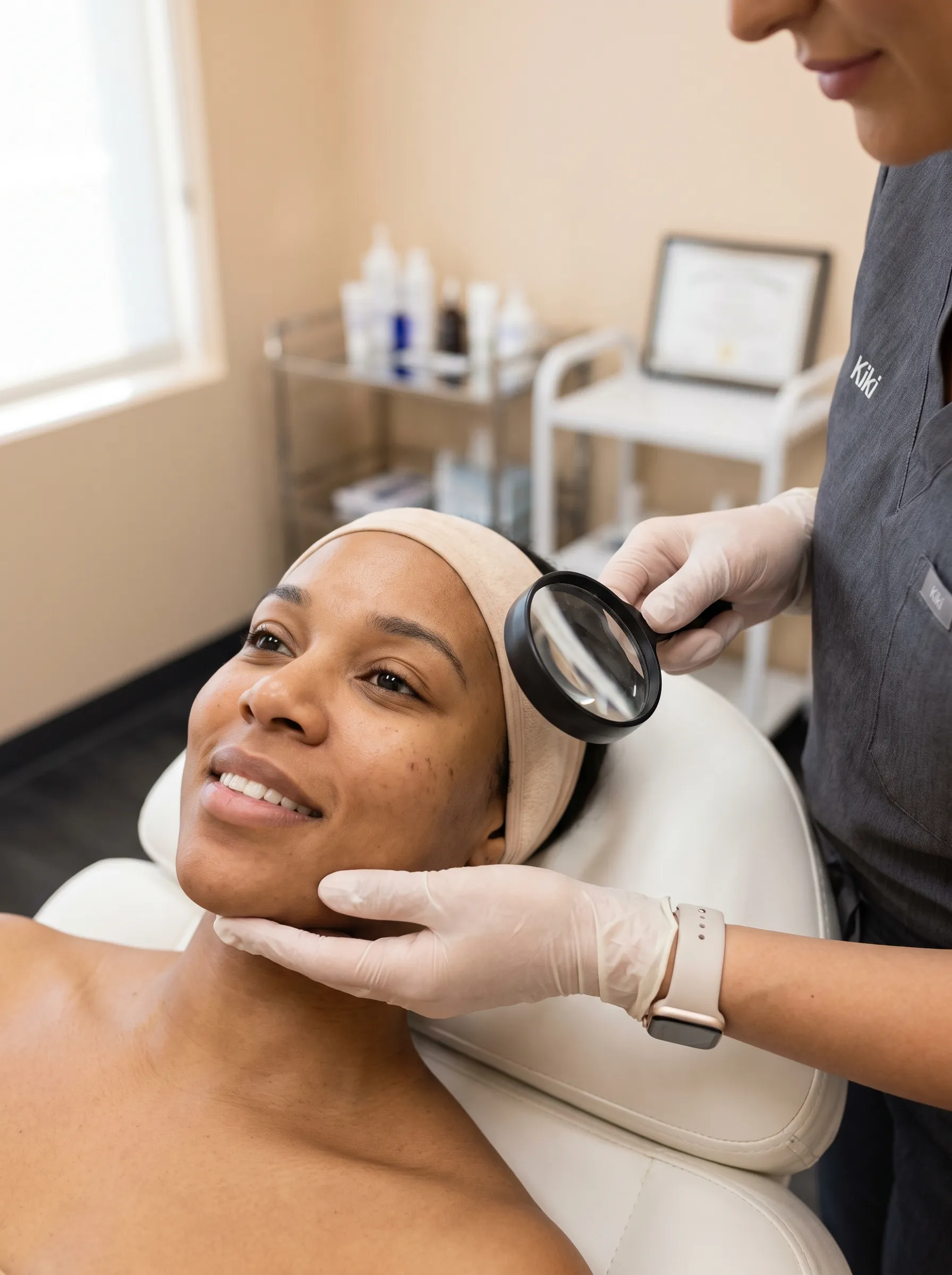
That is what the first visit is for. It is a consultation and a skin analysis, and the modality is chosen from what the skin is doing that day rather than from what arrived before it. The melasma page sets out how a pigment plan is paced, and what a facial here actually involves covers the assessment itself.
Where this leaves a client
A first visit is $249 and includes the consultation and skin analysis that turns any of this into a plan for the skin.
Prices are published, the studio is appointment-only, and parking is free.
Written by Kiki, Licensed Esthetician, California Board of Barbering & Cosmetology, with 7+ years treating melanin-rich skin at KIAMO Skin in San Diego.
Common questions
Dark spot questions
How long does it take to fade a dark spot at home?
Can I fade a dark spot with a strong home peel?
Does vitamin C fade dark spots?
Why does my dark spot keep coming back?
Should I use a retinoid, an azelaic acid or a vitamin C?
Rated 5 out of 5 stars. — 42 five-star Google reviews
“I've been going to KIAMO Skin for over a year and can't recommend it enough. Real, visible results.”
Also in the journal
Three kinds of dark mark, and why one facial cannot fix all three
Choosing a facial for hyperpigmentation before you know which kind you have is the most common reason treatment fails — and occasionally the reason it backfires.
June gloom is not sun protection
The marine layer is the single most expensive misunderstanding in San Diego skincare. It looks like cover. It is not cover.
San Diego hard water and your scalp
If your scalp flakes, itches, or feels coated no matter what shampoo you buy, the shampoo may not be the variable worth changing.
Microneedling on dark skin, and why depth decides the outcome
Not whether needling works on melanin-rich skin, but whether the depth was set correctly for the skin in front of the device.
Is dermaplaning safe for dark skin? Here is what actually matters.
The question is not really whether dermaplaning works on darker skin. It is whether the blade angle and pressure match the skin in front of it.
Professional Scalp Treatment San Diego: Keravive for Dandruff, Flaking & Hair Health
Professional scalp treatment in San Diego. Keravive for dandruff, seborrheic dermatitis, dry scalp and thinning, treating the cause rather than the symptom.
San Diego Scalp Treatments: How Does Keravive Work?
Keravive removes the buildup shampoo cannot reach. Here is what it does, and why San Diego water and sun make it necessary.
Hyperpigmentation Treatment Guide: What Actually Works for Dark Spots, Melasma & PIH
Stubborn dark spots, melasma or uneven tone in San Diego: what actually helps, and why it depends on your skin type.
How much does a chemical peel cost in San Diego?
The price of a chemical peel in San Diego varies by depth and formulation. The more important question is which one your skin needs.
Best chemical peel for melasma, and what the answer actually depends on
Best peel for melasma is a search query, not a clinical answer. Here is the peel your skin type can tolerate every four to six weeks.
Acne scars in San Diego: which ones a facial can fix and which need microneedling
Most of the time when a facial "didn't work" for acne scarring, the scar type was never the issue. The treatment was.
Dermaplaning or a chemical peel: which one actually changes your skin?
These two sound like competing versions of the same thing. One removes what is on top; the other changes what happens underneath.
Best sunscreen for dark spots in San Diego: what to look for on the label
Most sunscreen in San Diego is bought on brand and worn on habit. For a mark that keeps returning, the label matters more than the name.
Chemical peel or microchanneling: which one will clear your dark spots
These two work in opposite directions, one down from the surface and one up from beneath. Choosing wrongly can leave a mark darker.
Best treatment for dark spots on face: which one clears yours, and what each costs
Dark spots have different causes and sit at different depths, so the best treatment only makes sense once you know which one is yours.
Facial for sensitive skin: which modality suits a reactive barrier, and what each one costs
Sensitive skin is not a skin type, it is a condition — and the treatment that calms it can be the treatment that makes it worse.
How much does a facial cost in San Diego in 2026?
The published San Diego market rate for a facial spans a wide range. The gap between the two ends of it is not quality. It is what the price includes. First-time clients here start at $249.
How to prepare for a chemical peel, and the week before that does the most work
A peel is the treatment, but the week before it is what decides how the skin responds to it. On melanin-rich skin that difference is the difference between clearing pigment and making more of it.
How to get the most out of a HydraFacial, including what to do the day before
A HydraFacial is a maintenance treatment with a specific job. Doing the day before it right is a short list, and the routine between visits is what decides whether it holds.