10 min read · Field notes from the treatment room
Best chemical peel for melasma, and what the answer actually depends on
Best peel for melasma is a search query, not a clinical answer. Here is the peel your skin type can tolerate every four to six weeks.
First-time client treatment
$249
- By appointment only
- Free parking
- Free cancellation up to 48 hours before
For melasma on melanin-rich skin (Fitzpatrick IV–VI), a superficial-to-medium peel with mandelic or lactic acid at concentrations matched to your skin type is the safe choice, run as a series rather than one strong session. At KIAMO Skin in San Diego, the Lira Gentle Renewal Peel ($199) and Lira Advanced Peel ($299) use mandelic and lactic acids calibrated per skin tone, with tyrosinase-inhibitor prep between sessions and broad-spectrum SPF 50+ with iron oxides daily.
Rated 5 out of 5 stars. — 42 five-star Google reviews
- Written by Kiki, licensed esthetician
- Last updated October 1, 2026
- 42 five-star Google reviews
- Prices published before a booking is made
The clinically useful answer is more specific and harder to find: the right peel is the one your skin tone can tolerate every four to six weeks, repeated across a series, with melanin production quieted between sessions. Everything else is packaging.
KIAMO Skin offers melasma and hyperpigmentation treatment across San Diego neighborhoods from the San Diego studio, with the Lira Clinical peels designed around that constraint.
What kinds of peels are used for melasma?
Four peel families dominate the published melasma protocol: depigmentation systems like Cosmelan, glycolic acid at 30 to 70 percent, mandelic acid at 30 to 50 percent, and Jessner solution (lactic, salicylic, and resorcinol in ethanol). Each works through a different mechanism and carries a different safety profile on darker skin tones.
| Family | What it does | Best for | Risk on melanin-rich skin (IV–VI) |
|---|---|---|---|
| Cosmelan / Melanage | Two-step depigmentation mask; suppresses tyrosinase over weeks | Stubborn epidermal and dermal melasma, Fitzpatrick III–IV | Medium — formulation matters; the standard protocol stays at light depth |
| Glycolic acid 30–70% | AHA; speeds cell turnover to lift pigment | Mild-to-moderate epidermal melasma | Higher — deep peels (>50%) risk rebound pigmentation |
| Mandelic acid 30–50% | Large-molecule AHA; slower penetration | Sensitive skin, Fitzpatrick IV–VI, melasma with active inflammation | Lower — gentler, fits the no-deep-wound rule |
| Jessner solution | Lactic + salicylic + resorcinol; controlled layered peel | Combined epidermal + mild dermal pigment | Medium — depends on layer count and concentration |
The 2018 Indian Pigmentary Expert Group consensus on chemical peels in melasma explicitly cautions against high-concentration peels in skin of color and recommends escalating-strength protocols across a series rather than aggressive single sessions.
The Lira Clinical peels used at KIAMO Skin do not include it — they stay within the light-to-medium depth range by design.
What makes a peel safe on melanin-rich skin?
The safety criterion is whether the peel triggers inflammation severe enough to activate melanocytes. Mandelic acid wins on this score because its larger molecule penetrates more slowly, so it exfoliates without wounding. Glycolic acid works but only at concentrations matched to the skin on the day.
The result is not failure to treat the melasma. The result is new pigment forming where the peel was applied.
The "avoid deep peels" safety stance the published guidance keeps returning to is built into the protocol, not added as a footnote.
Each peel in the series is light. The cumulative effect is what addresses pigment at the cellular level.
What does a Lira melasma peel actually do?
The Lira Gentle Renewal Peel applies lactic and mandelic acids at concentrations matched to your Fitzpatrick classification. The peel sits for a controlled duration, then is neutralized. After neutralization, tyrosinase-inhibitor serums are applied and SPF is layered over.
Over the next four to six weeks, pigment lifts as cells turn over. The series is what produces measurable fading; the single peel refreshes.
The two together produce the fading that neither does alone. Melasma is a chronic condition. The protocol treats it that way.
How does San Diego's UV climate affect peel timing?
A melasma peel applied in late spring in San Diego, with the patient resuming unprotected outdoor activity, will reverse within weeks. The same peel in fall, with strict daily SPF, will hold for months. The peel is the lever. The season and the home routine are what decide whether the lever moves anything.
Car windows filter UVB but not UVA, so daily commuters get cumulative one-sided exposure on the driving-side cheek.
Melasma in those areas reflects that, and the peel protocol is timed accordingly. The closer to the coast, the more year-round humidity; the further inland, the more year-round direct sun.
What does realistic fading look like?
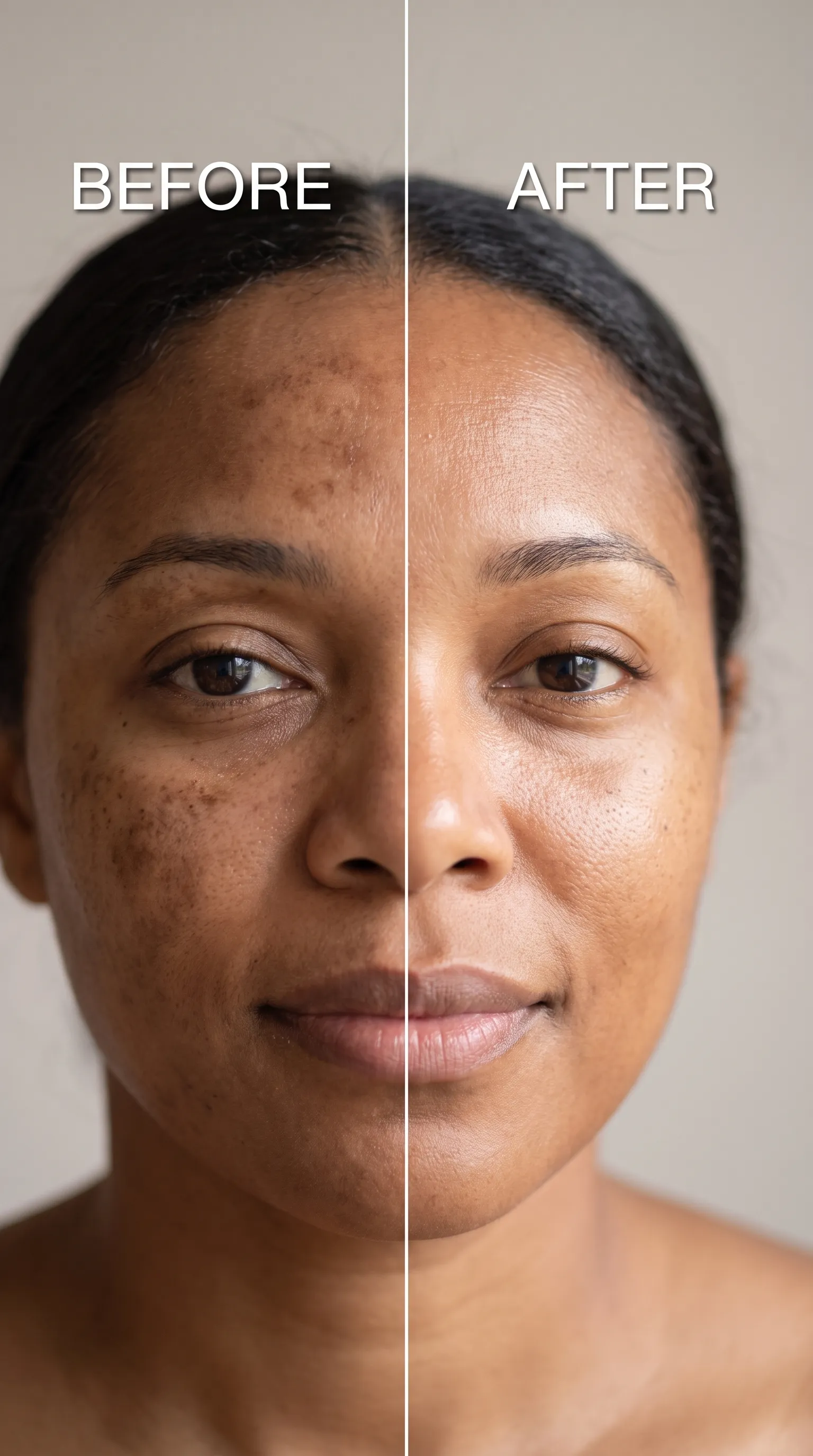
Measurable fading for epidermal melasma is typically 8 to 12 weeks into a prepared series, with continued improvement across the second and third peels. Dermal melasma — pigment that sits deeper — takes longer and may require combination work that includes dermatology-grade intervention beyond what an esthetician protocol covers.
The published literature is candid: StatPearls describes melasma as a chronic, relapsing pigmentary disorder best understood as chronic disease control rather than cure, with improvements "frequently transient in the absence of sustained photoprotection and maintenance therapy." That is the consensus the AAD and the consensus reviews all adopt.
The peel protocol here is paired with the home routine that protects the result between visits. The kind of mark you have decides what comes first; melasma is managed, not cured.
What should you ask before booking a melasma peel?
Ask two questions: whether the protocol is calibrated to your Fitzpatrick type, and whether the practitioner can answer why the peel they are recommending is safer than the alternatives for your skin tone.
The wrong peel on the wrong skin tone produces exactly the rebound pigment the protocol is trying to clear.
A good peel protocol is part of a broader plan, not the whole plan. KIAMO Skin's practice is built around that framing — melanin-rich skin as the whole discipline rather than a service line — so the answer that gets given at consultation is the one that fits the patient in front of the practitioner.
The studio is in San Diego at 3067 Reynard Way, five minutes from Hillcrest, Bankers Hill, and Little Italy, with free parking.
Where this leaves a client
A first visit is $249 and includes the consultation and skin analysis that turns any of this into a plan for the skin.
Prices are published, the studio is appointment-only, and parking is free.
Written by Kiki, Licensed Esthetician, California Board of Barbering & Cosmetology, with 7+ years treating melanin-rich skin at KIAMO Skin in San Diego.
Common questions
Melasma peel questions
Which peel is best for melasma on dark skin?
Is a chemical peel safe if I have melasma?
How many sessions of chemical peel does it take to fade melasma?
How long after a melasma peel does pigment fade?
What should you avoid after a melasma peel?
Rated 5 out of 5 stars. — 42 five-star Google reviews
“I've been going to KIAMO Skin for over a year and can't recommend it enough. Real, visible results.”
Also in the journal
Three kinds of dark mark, and why one facial cannot fix all three
Choosing a facial for hyperpigmentation before you know which kind you have is the most common reason treatment fails — and occasionally the reason it backfires.
June gloom is not sun protection
The marine layer is the single most expensive misunderstanding in San Diego skincare. It looks like cover. It is not cover.
San Diego hard water and your scalp
If your scalp flakes, itches, or feels coated no matter what shampoo you buy, the shampoo may not be the variable worth changing.
Microneedling on dark skin, and why depth decides the outcome
Not whether needling works on melanin-rich skin, but whether the depth was set correctly for the skin in front of the device.
Is dermaplaning safe for dark skin? Here is what actually matters.
The question is not really whether dermaplaning works on darker skin. It is whether the blade angle and pressure match the skin in front of it.
Professional Scalp Treatment San Diego: Keravive for Dandruff, Flaking & Hair Health
Professional scalp treatment in San Diego. Keravive for dandruff, seborrheic dermatitis, dry scalp and thinning, treating the cause rather than the symptom.
San Diego Scalp Treatments: How Does Keravive Work?
Keravive removes the buildup shampoo cannot reach. Here is what it does, and why San Diego water and sun make it necessary.
Hyperpigmentation Treatment Guide: What Actually Works for Dark Spots, Melasma & PIH
Stubborn dark spots, melasma or uneven tone in San Diego: what actually helps, and why it depends on your skin type.
How much does a chemical peel cost in San Diego?
The price of a chemical peel in San Diego varies by depth and formulation. The more important question is which one your skin needs.
Acne scars in San Diego: which ones a facial can fix and which need microneedling
Most of the time when a facial "didn't work" for acne scarring, the scar type was never the issue. The treatment was.
Dermaplaning or a chemical peel: which one actually changes your skin?
These two sound like competing versions of the same thing. One removes what is on top; the other changes what happens underneath.
Best sunscreen for dark spots in San Diego: what to look for on the label
Most sunscreen in San Diego is bought on brand and worn on habit. For a mark that keeps returning, the label matters more than the name.
Chemical peel or microchanneling: which one will clear your dark spots
These two work in opposite directions, one down from the surface and one up from beneath. Choosing wrongly can leave a mark darker.
Best treatment for dark spots on face: which one clears yours, and what each costs
Dark spots have different causes and sit at different depths, so the best treatment only makes sense once you know which one is yours.
Facial for sensitive skin: which modality suits a reactive barrier, and what each one costs
Sensitive skin is not a skin type, it is a condition — and the treatment that calms it can be the treatment that makes it worse.
How much does a facial cost in San Diego in 2026?
The published San Diego market rate for a facial spans a wide range. The gap between the two ends of it is not quality. It is what the price includes. First-time clients here start at $249.
How to fade dark spots at home, and the three things that make them darker
Most home routines for dark marks fail in the same three places, and none of them is the product. The order, the light protection, and what happens in the week after a spot clears.
How to prepare for a chemical peel, and the week before that does the most work
A peel is the treatment, but the week before it is what decides how the skin responds to it. On melanin-rich skin that difference is the difference between clearing pigment and making more of it.
How to get the most out of a HydraFacial, including what to do the day before
A HydraFacial is a maintenance treatment with a specific job. Doing the day before it right is a short list, and the routine between visits is what decides whether it holds.