18 min read · Field notes from the treatment room
Hyperpigmentation Treatment Guide: What Actually Works for Dark Spots, Melasma & PIH
Stubborn dark spots, melasma or uneven tone in San Diego: what actually helps, and why it depends on your skin type.
First-time client treatment
$249
- By appointment only
- Free parking
- Free cancellation up to 48 hours before
Rated 5 out of 5 stars. — 42 five-star Google reviews
- Written by Kiki, licensed esthetician
- Last updated August 28, 2026
- 42 five-star Google reviews
- Prices published before a booking is made
While any skin tone can develop pigmentation concerns, melanin-rich skin has more reactive melanocytes that make post-inflammatory hyperpigmentation significantly more likely.
This guide synthesizes the latest dermatological research from 2022-2025, including breakthrough studies on tranexamic acid, picosecond laser safety for darker skin tones, and evidence-based combination protocols.
What is hyperpigmentation and why does it happen?
Hyperpigmentation is any condition where patches of skin become darker than surrounding areas due to excess melanin production. Melanocytes become overactive in response to triggers including UV radiation, inflammation, hormonal fluctuations, and skin injury.
In melanin-rich skin (Fitzpatrick types IV-VI), melanocytes are inherently more reactive—a protective adaptation against UV damage that unfortunately makes these skin tones more susceptible to hyperpigmentation following inflammation or injury.
This is especially true in inland areas like Chula Vista where the marine layer doesn't provide the same UV diffusion as coastal neighborhoods, and where melanin-rich skin demographics make melasma one of the most common reasons clients seek treatment.
Melasma, PIH, and sun spots: What is the difference?
Melasma is hormonally triggered symmetric pigmentation often on cheeks and forehead, while post-inflammatory hyperpigmentation develops after acne, injury, or inflammation. Sun spots result from cumulative UV damage and appear as discrete brown spots on sun-exposed areas.
Women of color and those with melanin-rich skin are disproportionately affected.
The darkened areas follow the exact location of the previous injury rather than forming symmetric patterns.
Solar lentigines appear as well-defined brown spots on chronically sun-exposed areas: face, chest, hands, arms, and shoulders. These represent cumulative UV damage over years or decades.
Sun spots are permanent without treatment but do not worsen unless UV exposure continues.
How long does hyperpigmentation take to fade?
Untreated post-inflammatory hyperpigmentation typically persists for 18-24 months, though epidermal pigmentation responds to treatment within 8-12 weeks while deeper dermal pigmentation may take 6-12 months or longer. Melasma requires ongoing maintenance with high recurrence rates without sun protection.
Expect measurable improvement in 8-12 weeks with consistent treatment and strict sun protection.
This type requires professional treatments like chemical peels that can reach the dermal layer. Even with professional intervention, expect 6-12 months for significant improvement.
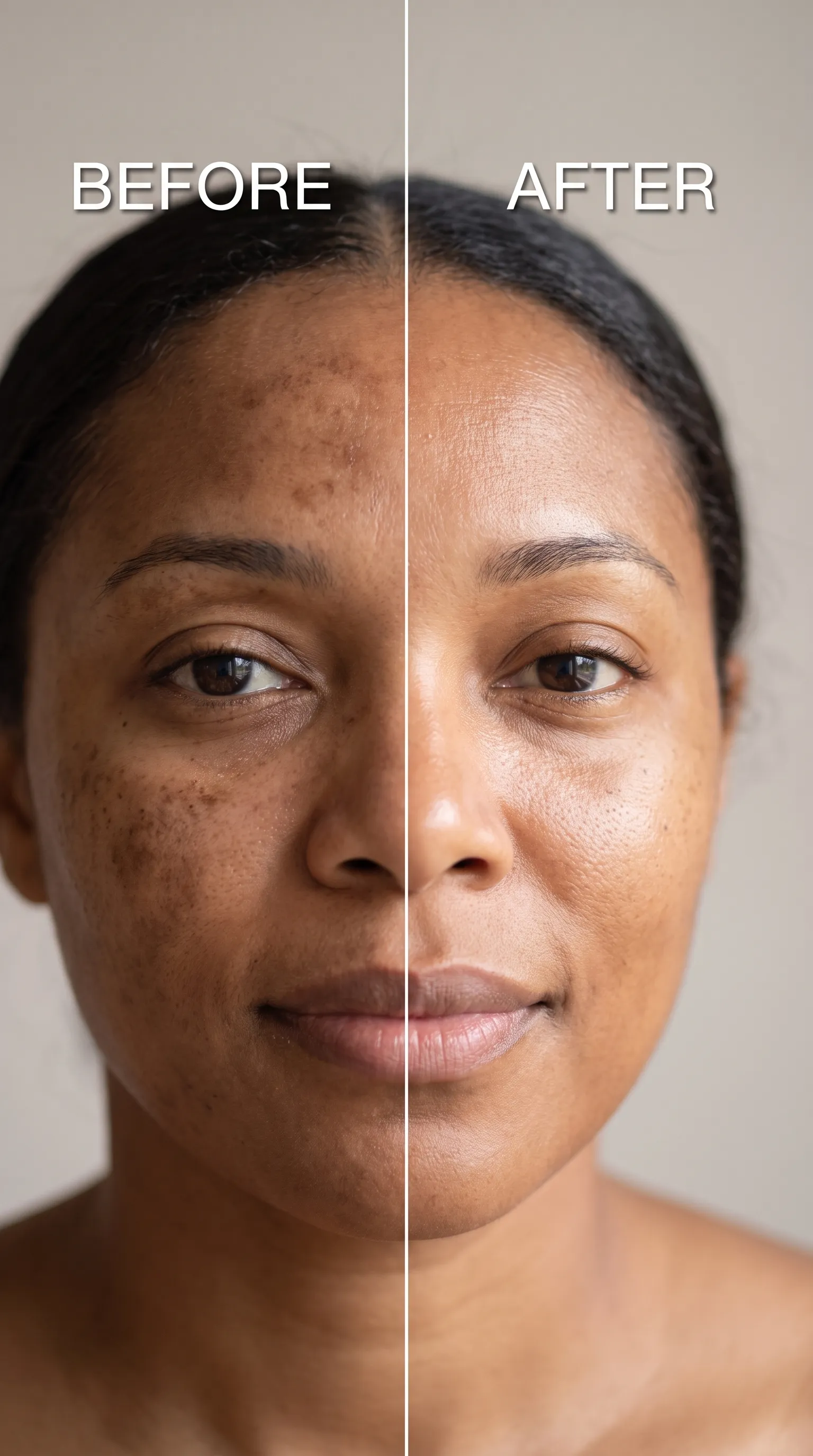
After consistent treatment with medical-grade lightening agents, a series of targeted chemical peels, and unwavering commitment to mineral sunscreen with iron oxides, the improvement was striking: visibly clearer, more even-toned skin with the majority of the hyperpigmentation faded.
The key factors in success: starting with realistic expectations (6-12 months for significant improvement, not 6 weeks), understanding that melasma requires ongoing maintenance rather than a cure, committing to daily sunscreen regardless of weather or plans, and working with a provider who understands the unique challenges of treating pigmentation in melanin-rich skin.
Effective pigmentation treatment requires sustained commitment measured in months, not weeks.
Even after achieving significant lightening, maintenance treatment and sun protection must continue indefinitely. Most patients who discontinue treatment see recurrence within 6-12 months.
Is treatment different for darker skin tones?
Yes—melanin-rich skin (Fitzpatrick types IV-VI) requires modified treatment protocols because more reactive melanocytes increase the risk of post-inflammatory hyperpigmentation from aggressive treatments. Certain laser wavelengths, chemical peel concentrations, and even some topical actives must be adjusted.
The fundamental challenge: the very treatments designed to reduce pigmentation can paradoxically cause more pigmentation if applied too aggressively. Research consistently shows that individuals with skin of color experience treatment efficacy gaps partly because protocols developed primarily on lighter skin tones do not translate directly.
This phenomenon—treatment-induced post-inflammatory hyperpigmentation—is why providers experienced in treating melanin-rich skin take a conservative, staged approach rather than pursuing maximum strength from the first session.
Safer options include 1064nm Nd:YAG lasers and newer picosecond technology at longer wavelengths. Studies from 2025 show that 730nm picosecond lasers can safely treat melasma in Chinese patients (Fitzpatrick III-IV) with minimal PIH risk—a significant advancement over previous technology.
Instead, protocols use lower concentrations (TCA 10-15%, glycolic acid 20-30%), longer intervals between treatments (6-8 weeks instead of 4 weeks), and extensive pre-treatment with skin lightening agents to stabilize melanocytes.
Visible light also stimulates melanin production, which is why mineral sunscreens containing iron oxides (which physically block visible light) outperform chemical sunscreens for pigmentation concerns.
Pre-treatment always includes tyrosinase inhibitors for 2-4 weeks before any professional treatment. The pacing matters more than the strength—slower, consistent progress prevents the inflammatory cascade that triggers post-inflammatory hyperpigmentation in reactive skin.
The studio does not use one-size-fits-all protocols—every treatment plan is adjusted based on the client's specific Fitzpatrick type, pigmentation depth (epidermal versus dermal), trigger factors (hormonal, inflammatory, UV), and treatment history.
This preparation significantly reduces the risk of rebound hyperpigmentation—a common complication when aggressive treatments are applied to unprepared melanin-rich skin.
Non-compliance with post-treatment protocols is the primary cause of treatment complications.
What ingredients actually work for hyperpigmentation?
The most evidence-backed ingredients are hydroquinone (2-4%), tranexamic acid, retinoids, azelaic acid, niacinamide, kojic acid, and vitamin C—each working through different mechanisms to reduce melanin production or promote cell turnover. Combination approaches consistently outperform single-ingredient treatments.
Effective treatment requires combining multiple mechanisms—inhibiting melanin production, accelerating cell turnover, reducing inflammation, and blocking UV/visible light—sustained over months.
However, the FDA has issued warnings about ochronosis with prolonged use. Recommended protocol: cycle 3 months on, 3 months off.
It works through dual mechanisms: inhibiting melanin synthesis and reducing the vascular component of melasma.
Start with lower concentrations applied 2-3 times weekly, gradually increasing to nightly. Expect improvement around the 12-week mark.
Azelaic acid (15-20%) inhibits tyrosinase while reducing inflammation—particularly valuable for patients whose hyperpigmentation coexists with acne or rosacea. One of the few actives safe during pregnancy.
The key: combination therapy. Using multiple ingredients with complementary mechanisms produces synergistic effects that exceed any single ingredient alone.
Building an effective routine
Morning routine: Gentle cleanser, vitamin C serum (pH 3-3.5), niacinamide or azelaic acid, moisturizer, mineral sunscreen SPF 50+ with iron oxides.
Evening routine: Double cleanse, treatment serum (tranexamic acid, kojic acid, or hydroquinone if prescribed), retinoid, moisturizer.
Product layering rules: Vitamin C first on bare skin; wait 1-2 minutes between actives; never combine vitamin C and retinoid in same routine; introduce one new active at a time (2-4 weeks apart) to identify irritation sources.
It also strengthens the skin barrier and reduces inflammation. Niacinamide pairs well with virtually all other actives and rarely causes irritation.
Look for stabilized formulations in opaque, airtight packaging, as vitamin C degrades rapidly when exposed to light and air.
While effective, it can cause irritation in some users. Cysteamine 5% cream shows comparable efficacy to hydroquinone in 2024 research without the ochronosis risk, making it an emerging alternative for long-term use.
Which professional treatments are most effective?
Chemical peels, microneedling, and laser treatments accelerate pigmentation improvement when combined with medical-grade topicals, with combination protocols showing 94% patient preference over single modalities. Treatment selection depends on pigmentation type, skin tone, and depth.
Treatments are spaced 6-8 weeks apart rather than the typical 4 weeks. Results appear gradually: most clients see measurable improvement after 3-4 treatments in a series.
The procedure is safe for all skin tones and generates minimal heat. Downtime is minimal: redness for 24-48 hours. Most clients achieve optimal results with 3-6 sessions spaced 4-6 weeks apart.
This approach eliminates the post-inflammatory hyperpigmentation risk that even newer picosecond lasers can trigger in reactive melanocytes.
Understanding laser technology for pigmentation
Laser treatments for pigmentation have evolved dramatically over the past five years, with newer technology offering significantly improved safety profiles for darker skin tones. However, understanding the risks remains essential.
Older technology (higher PIH risk for dark skin): Q-switched Nd:YAG at 532nm; Q-switched alexandrite at 755nm; Intense pulsed light (IPL). These carry significant risk for post-inflammatory hyperpigmentation in melanin-rich skin.
Safer modern options: 1064nm Nd:YAG (longer wavelength means less melanin absorption in surrounding skin); Picosecond lasers (730nm, 755nm, 1064nm); Fractionated non-ablative lasers.
Less heat equals less inflammation equals lower PIH risk. 2025 research on 730nm picosecond lasers demonstrates effective melasma treatment in Asian skin (Fitzpatrick III-IV) with minimal adverse effects.
Some melasma actually worsens with laser treatment—which is why test spots and conservative settings are essential, especially for darker skin.
What is safe for hyperpigmentation during pregnancy?
Pregnant and breastfeeding individuals should avoid retinoids and hydroquinone, but safe evidence-backed alternatives include azelaic acid, niacinamide, kojic acid, vitamin C, and glycolic acid at appropriate concentrations. Strict mineral sunscreen use (SPF 50+ with zinc oxide or titanium dioxide) is the single most important preventive measure.
Pregnancy-triggered melasma (often called the mask of pregnancy or chloasma) affects up to 70% of pregnant individuals due to hormonal surges that stimulate melanocytes. The increased estrogen, progesterone, and melanocyte-stimulating hormone create the perfect storm for pigmentation—especially when combined with UV exposure.
AVOID during pregnancy and breastfeeding: Hydroquinone (Category C—limited human data, potential risk); Retinoids including tretinoin, adapalene, tazarotene (Category C-X—known teratogenic effects); High-strength chemical peels (TCA greater than 10%); Most oral medications including tranexamic acid.
SAFE alternatives backed by evidence: Azelaic acid 15-20% (Category B—safe during pregnancy); Niacinamide 4-5% (well-tolerated, no contraindications); Kojic acid 1-4% (limited but reassuring data); Vitamin C 10-20% (topical vitamin C is safe); Glycolic acid peels 20-30% (superficial peels only, limited systemic absorption).
Choose SPF 50+, apply generously, and reapply every 2 hours during sun exposure. Many patients see spontaneous improvement in pregnancy-related melasma within 6-12 months postpartum as hormones normalize.
Managing hyperpigmentation in San Diego's climate
San Diego's year-round sun exposure (averaging 266 sunny days and high UV index) makes consistent photoprotection essential—even brief car rides or outdoor walks can trigger melanin production. Mineral sunscreens with iron oxides provide protection against both UV and visible light.
Living in San Diego creates unique challenges. While other regions experience seasonal UV variation, San Diego maintains a UV index of 5-7 even in December and January—requiring year-round vigilance that many patients underestimate.
Late afternoon seemed safe, but San Diego's UV index stays at 6-8 until sunset during summer. After shifting walks to before 9am and adding a wide-brimmed hat, the pigmentation finally started improving.
San Diego sunscreen protocol: Mineral sunscreen SPF 50+ with zinc oxide or titanium dioxide; must contain iron oxides (look for tinted formulations); apply generously morning and reapply every 2 hours during outdoor activities; apply sunscreen even if staying home—UVA penetrates windows.
Common San Diego UV exposure mistakes
Cloud cover removes the warmth that people use to judge risk while letting a large share of ultraviolet through. The marine layer is not a substitute for sunscreen.
This cumulative exposure contributes to pigmentation on the left side of the face (driver side) and hands. Apply sunscreen before morning commutes and consider UV-blocking window film.
Visible light from screens and indoor lighting can also darken melasma in susceptible individuals.
Sitting under an umbrella or pergola reduces direct sun but does not eliminate reflected UV. Reapplication every 2 hours is mandatory, not optional.
Why does hyperpigmentation keep coming back?
Melasma is a chronic condition with near-certain recurrence without ongoing maintenance because hormonal and UV triggers remain active, making it manageable but not permanently cured. PIH and sun spots can also return if the underlying causes (inflammation, sun exposure, picking) are not addressed alongside treatment.
Common mistakes that cause recurrence: Stopping sunscreen after improvement; discontinuing all actives once pigmentation fades; one sunburn undoing months of progress; picking and touching affected areas; using irritating products that trigger inflammation; hormonal changes (starting or stopping birth control, pregnancy, menopause).
After achieving significant improvement (typically 60-80% lightening after 4-6 months of active treatment), clients transition to a maintenance phase: prescription retinoid 2-3 nights per week to maintain cell turnover, vitamin C or niacinamide serum every morning for ongoing tyrosinase inhibition, and mineral sunscreen with iron oxides as a non-negotiable daily step.
The clients who maintain their results long-term are the ones who accept that pigmentation management is ongoing—not a 3-month sprint followed by abandoning all protocols.
The maintenance phase costs significantly less than active treatment, a fraction of what an intensive phase runs, while preventing the frustrating cycle of improvement followed by complete relapse.
What about chemical peels versus laser treatments?
A typical protocol involves 4-6 treatments spaced 4-8 weeks apart, with maintenance peels every 3-6 months.
The depth and acid type must be carefully selected based on skin tone and pigmentation depth.
For lighter skin tones (Fitzpatrick I-III): Glycolic acid 30-70%, Salicylic acid 20-30%, TCA 15-25%, Jessner's solution.
For melanin-rich skin (Fitzpatrick IV-VI): Lower concentrations: glycolic 20-30%, salicylic 20%, TCA 10-15%; longer intervals between treatments (6-8 weeks versus 4 weeks); mandatory pre-treatment with tyrosinase inhibitors for 2-4 weeks to stabilize melanocytes.
Downtime ranges from none (superficial peels) to 5-7 days of visible peeling (medium-depth peels). Expect redness, flaking, and temporary darkening before the lightening effect becomes visible at 2-4 weeks post-treatment.
When should you see a provider?
See a dermatology or aesthetic provider if over-the-counter products have not improved your pigmentation after 12 weeks, if you need prescription-strength treatments, or if you are unsure whether your pigmentation is melasma, PIH, or another condition. Professional evaluation is especially important for melanin-rich skin.
You leave with a phased treatment plan, home care recommendations, and realistic expectations. The studio is located in San Diego at 3067 Reynard Way, five minutes from Hillcrest, Bankers Hill, and Little Italy, with free parking. Request appointments through Vagaro or call (310) 595-0872.
Where this leaves a client
A first visit is $249 and includes the consultation and skin analysis that turns any of this into a plan for the skin.
Prices are published, the studio is appointment-only, and parking is free.
Written by Kiki, Licensed Esthetician, California Board of Barbering & Cosmetology, with 7+ years treating melanin-rich skin at KIAMO Skin in San Diego.
Common questions
Hyperpigmentation questions
Can hyperpigmentation be permanently cured?
Is laser treatment safe for dark spots on dark skin?
What SPF should I use to prevent hyperpigmentation?
Can I use retinol and vitamin C together for dark spots?
Rated 5 out of 5 stars. — 42 five-star Google reviews
“I've been going to KIAMO Skin for over a year and can't recommend it enough. Real, visible results.”
Also in the journal
Three kinds of dark mark, and why one facial cannot fix all three
Choosing a facial for hyperpigmentation before you know which kind you have is the most common reason treatment fails — and occasionally the reason it backfires.
June gloom is not sun protection
The marine layer is the single most expensive misunderstanding in San Diego skincare. It looks like cover. It is not cover.
San Diego hard water and your scalp
If your scalp flakes, itches, or feels coated no matter what shampoo you buy, the shampoo may not be the variable worth changing.
Microneedling on dark skin, and why depth decides the outcome
Not whether needling works on melanin-rich skin, but whether the depth was set correctly for the skin in front of the device.
Is dermaplaning safe for dark skin? Here is what actually matters.
The question is not really whether dermaplaning works on darker skin. It is whether the blade angle and pressure match the skin in front of it.
Professional Scalp Treatment San Diego: Keravive for Dandruff, Flaking & Hair Health
Professional scalp treatment in San Diego. Keravive for dandruff, seborrheic dermatitis, dry scalp and thinning, treating the cause rather than the symptom.
San Diego Scalp Treatments: How Does Keravive Work?
Keravive removes the buildup shampoo cannot reach. Here is what it does, and why San Diego water and sun make it necessary.
How much does a chemical peel cost in San Diego?
The price of a chemical peel in San Diego varies by depth and formulation. The more important question is which one your skin needs.
Best chemical peel for melasma, and what the answer actually depends on
Best peel for melasma is a search query, not a clinical answer. Here is the peel your skin type can tolerate every four to six weeks.
Acne scars in San Diego: which ones a facial can fix and which need microneedling
Most of the time when a facial "didn't work" for acne scarring, the scar type was never the issue. The treatment was.
Dermaplaning or a chemical peel: which one actually changes your skin?
These two sound like competing versions of the same thing. One removes what is on top; the other changes what happens underneath.
Best sunscreen for dark spots in San Diego: what to look for on the label
Most sunscreen in San Diego is bought on brand and worn on habit. For a mark that keeps returning, the label matters more than the name.
Chemical peel or microchanneling: which one will clear your dark spots
These two work in opposite directions, one down from the surface and one up from beneath. Choosing wrongly can leave a mark darker.
Best treatment for dark spots on face: which one clears yours, and what each costs
Dark spots have different causes and sit at different depths, so the best treatment only makes sense once you know which one is yours.
Facial for sensitive skin: which modality suits a reactive barrier, and what each one costs
Sensitive skin is not a skin type, it is a condition — and the treatment that calms it can be the treatment that makes it worse.
How much does a facial cost in San Diego in 2026?
The published San Diego market rate for a facial spans a wide range. The gap between the two ends of it is not quality. It is what the price includes. First-time clients here start at $249.
How to fade dark spots at home, and the three things that make them darker
Most home routines for dark marks fail in the same three places, and none of them is the product. The order, the light protection, and what happens in the week after a spot clears.
How to prepare for a chemical peel, and the week before that does the most work
A peel is the treatment, but the week before it is what decides how the skin responds to it. On melanin-rich skin that difference is the difference between clearing pigment and making more of it.
How to get the most out of a HydraFacial, including what to do the day before
A HydraFacial is a maintenance treatment with a specific job. Doing the day before it right is a short list, and the routine between visits is what decides whether it holds.