Skip to content
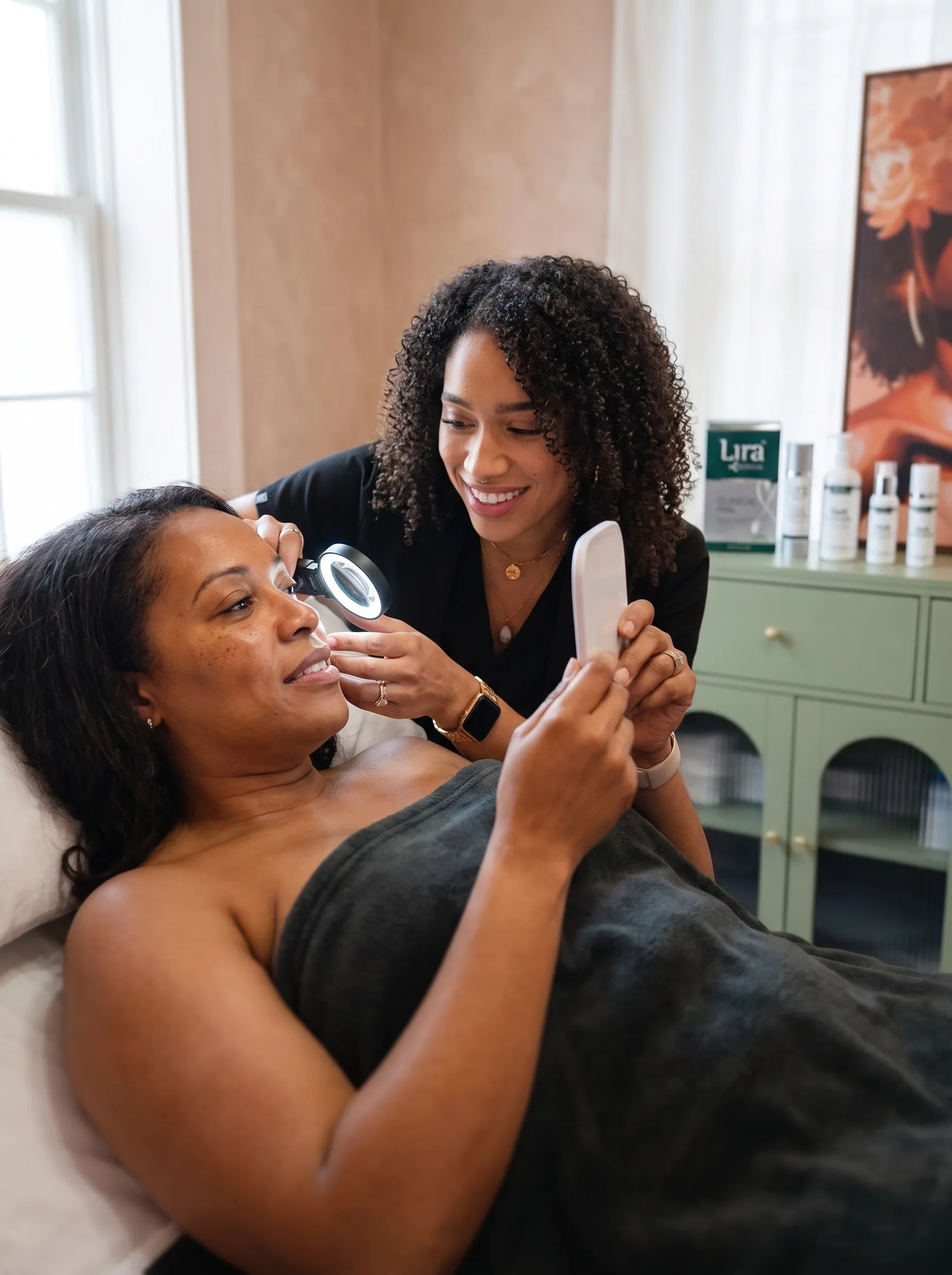
LIRA chemical peel for melasma at La Mesa, inland from the marine layer

La Mesa, San Diego, CA

Hyperpigmentation Treatment in La Mesa, San Diego

Inland pigment, at inland depth.

Years of high UV past the marine layer produce deeper, more established pigment than the coastal kind, and it responds to a different depth of correction. KIAMO Skin assembles the plan from peels, microchanneling and brightening HydraFacials, and writes the daily SPF into it because the exposure here does not take a day off. The plan and its price are set at the consultation.

LIRA Chemical Peels

$199–$299

  • By appointment only
  • Free parking
  • Consultations included — the plan is set before a booking is made
  • Calibrated for every Fitzpatrick type
  • SPF with iron oxides built into the plan
  • Addresses the source, not just the mark
  • Peels from $199, microchanneling $475

About KIAMO Skin

Last updated 21 November 2026

  • KIAMO Skin performs every treatment in one private treatment room at 3067 Reynard Way in Mission Hills, San Diego.
  • KIAMO Skin is a licensed facial spa. Kiki, a California licensed esthetician with 7+ years in corrective skin work, performs every treatment personally.
  • KIAMO Skin publishes every price before a booking is made — the first visit is $249, and a HydraFacial is $259.
  • KIAMO Skin treats every Fitzpatrick type from I to VI, and raises peel strength only as the barrier allows.
  • KIAMO Skin is by appointment only, with free parking on site and free cancellation up to 48 hours before.
  • Licensed esthetician — California Board of Barbering & CosmetologyKiki performs every treatment, in a one-to-one private studio in San Diego.
  • 7+ years of corrective skin workAdvanced training in HydraFacial Syndeo, Procell microchanneling, DMK enzyme therapy, and LIRA Clinical peels.
  • Prices published before a booking is madeNothing is quoted at the door, and the first visit includes the consultation that decides the plan.

Rated 5 out of 5 stars. — 42 five-star Google reviews

Verified on 2026-11-19 · Independent of KIAMO Skin

“The drive from La Mesa on I-8 is nothing once you see the results. My melasma has visibly faded after three sessions — something nothing else touched.”
— Marisol V., Google · La Mesa

Every Google review of KIAMO Skin is published in full, named and dated, at the reviews page.

Quick Answer

KIAMO Skin corrects post-inflammatory hyperpigmentation for La Mesa clients at a one-room facial spa in Mission Hills, about eleven miles west on I-8 — fifteen to twenty minutes off-peak, with free parking on site. Kiki, a California licensed esthetician with 7+ years, treats dark marks with LIRA chemical peels from $199, Procell microchanneling at $475 and HydraFacial at $259, calibrated to the Fitzpatrick type rather than to a general protocol. La Mesa sits past the marine layer, so the inland ultraviolet load that keeps producing new pigment runs higher than it does on the coast.

The approach

Why La Mesa clients book a correction rather than another brightening product

The products La Mesa clients have already tried work on the surface. The marks they describe sit in the surface and the mid-layers of the skin, and they were produced by an inflammatory response that a product does not reach. Kiki has 7+ years correcting post-inflammatory hyperpigmentation across every Fitzpatrick type, and the work is done on one plan with one practitioner: the same person who reads the depth of the pigment at the first visit performs every session and raises the strength only as the barrier allows. In melanin-rich skin, where the marks run deeper and last longer, that discipline is the treatment rather than an extra precaution.

The local concern

Why is sun exposure worse inland?

La Mesa sits about ten miles from the coast, which is far enough to miss the marine layer that keeps the beach gray through May and June. Summer afternoons run roughly eight to fifteen degrees warmer than La Jolla or Mission Beach, and La Mesa falls inside the valley heat advisories the coast never gets. More clear days, year after year, is what builds the cumulative UV load behind the melasma and uneven tone this area books for. Lira chemical peels answer that, because strength escalates across a series rather than in one visit — and daily SPF is what holds the result.

Landmarks in La Mesa

  • La Mesa Village
  • La Mesa Boulevard
  • Spring Street trolley station
  • Mt. Helix
  • Mt. Helix cross
  • Grossmont Center
  • Jackson Drive
  • Fletcher Hills

What sets it apart

What a La Mesa hyperpigmentation plan actually does

The correction is sequenced, and the sequence is set by the assessment rather than by the calendar:

  • The mark identified first — post-inflammatory, melasma, or sun damage — because each one responds to a different instrument
  • Depth and barrier condition read before anything is applied, so the first treatment is not a guess
  • LIRA peel strength selected for the skin tone and escalated only across the series, never inside a single visit
  • Mineral SPF with iron oxides prescribed daily, because visible light drives pigment and a UV-only sunscreen does not block it
  • The whole course mapped at the first appointment, so the eleven-mile drive is planned around rather than squeezed in

The process

How a dark-mark correction runs at KIAMO Skin

Three steps, in this order, and the order is the treatment. Identifying what the mark actually is decides the instrument; assessing the condition of the skin decides whether that instrument is safe yet; and spacing the corrections far enough apart decides whether they hold.

  1. 01

    Identify the mark

    Post-inflammatory marks, melasma and sun damage look alike on the surface and behave differently underneath, and choosing the wrong approach is the most common reason a correction fails. For a La Mesa client the two that usually have to be separated are the marks left by an old acne episode and the symmetrical darkening that has arrived across the cheeks over a summer. The consultation establishes which is which, and it is the first thing that happens.

  2. 02

    Assess the skin

    Pigmentation does not exist independently of the rest of the skin. Inland heat and low humidity leave the barrier dehydrated, and a peel applied to a dehydrated barrier produces inflammation, which produces more pigment. The assessment looks at dehydration, congestion, irritation and barrier disruption together, and it is what decides whether the first visit is a peel, an enzyme treatment, or a HydraFacial that keeps the barrier stable until a peel is safe.

  3. 03

    Correct, then hold it

    An appropriate treatment is selected and spaced far enough apart for the skin to recover, and then daily SPF does the holding — because a new mark keeps arriving if the inflammation does. For La Mesa that last part decides the outcome. The same clear afternoons that built the pigment are still coming, and a correction without a daily protocol fades and returns.

Why La Mesa's dark marks behave differently

La Mesa sits about ten miles inland, east of Mission Valley, and that distance is doing more work than it looks. It is far enough that the marine layer which keeps the coast gray through May and June mostly misses it. Summer afternoons in the foothills run eight to fifteen degrees warmer than Mission Beach, and the neighborhood falls inside the valley heat advisories the coast never gets. More clear days year after year, plus heat the ocean is not moderating, is why the marks on a La Mesa face behave differently from the same marks two miles from the sand.

Heat is not a side note in pigment. Hormones, ultraviolet light and heat are the three drivers of melasma, and La Mesa supplies two of them, reliably, from May through September. The result is a face that darkens gradually across a summer — symmetrically, on the upper lip, the cheeks and the forehead. That pattern is easy to recognise and easy to misdiagnose, because it arrives alongside the marks left by acne, and the two behave nothing alike.

So the first job in the room is separating them. A dark mark that turned up with a breakout and stayed behind is post-inflammatory hyperpigmentation: the skin's response to injury, and the pigment sits where the injury was. Symmetrical darkening across the cheeks that arrived on its own over a summer is melasma. A field of uneven tone across the forehead, nose and cheekbones that has been there for years is sun damage, and it clusters on the highest-exposure areas. They sit in different layers, they respond to different instruments, and a peel built for one applied to another is the single most common reason a correction stalls. The three kinds of dark mark are worth reading before the first appointment rather than after the third.

What the assessment changes for inland skin

Pigmentation does not exist independently of the rest of the skin, and that is where La Mesa differs most from the coastal version of this problem. The air inland is drier, the afternoons are hotter, and a face that has spent years in that climate is frequently dehydrated without looking dry — tight after washing, reactive to a moisturizer that used to be fine, pink for an hour after a hot day. Dehydration does not cause the marks, but it changes how the skin responds to being treated.

This is the practical reason the order of the plan matters. A peel applied to a barrier that is already dehydrated produces an inflammatory response the skin cannot resolve cleanly, and inflammation produces pigment. The correction intended to remove the mark becomes the reason a new one appears. It is also the reason some La Mesa clients begin with DMK enzyme therapy at $279 rather than with a peel, and some begin with a HydraFacial at $259: the one that establishes hydration and tests reactivity before anything stronger is applied.

The assessment also reads depth. Pigment sitting in the surface layer behaves differently from pigment that has descended into the mid-layers over years, and the two are reached differently. That read is what sets the starting strength of the peel and whether Procell microchanneling at $475 needs to be part of the course, since it works mechanically and reaches deeper than a peel does.

How the plan is assembled

The plan is not a package. It is assembled from LIRA chemical peels at $199 for the Gentle Renewal formulation and $299 for the Advanced, and it is built around one rule: the strength escalates across the series, never inside a single visit. The first peel is the conservative one, and the second is calibrated on what the first showed rather than on what a protocol says should come next.

The peel is the standard first step because it reaches the pigment. But it is not the only instrument, and a plan that uses only one instrument is a plan that has been chosen before the skin was looked at. Procell microchanneling at $475, or $1,199 for a series of three, is used where the marks sit alongside texture or scarring — it works mechanically, with no heat and no light, which matters on skin that reacts to both. Dermaplaning at $199 clears the surface buildup that stops a peel from penetrating evenly, which is why it appears in a plan as preparation rather than as an afterthought.

Between the corrective sessions sits the maintenance layer, and it is the piece most clients underestimate. A HydraFacial at $259 is the usual one, with a brightening booster chosen for the pigment rather than a general one. It keeps the barrier hydrated between peels, and it keeps the skin receptive to the next peel.

And then there is the daily work, which is not a treatment at all. Mineral SPF with iron oxides, applied every day, is built into the plan because visible light is a pigment driver in its own right and a UV-only sunscreen does not block it. A tyrosinase inhibitor supports the work between appointments. Without that daily layer, the correction fades and returns — and in La Mesa the exposure that caused the problem is not a season away, it is next Tuesday.

Seasoning the series around the valley heat

Timing is not a scheduling detail here. A peel leaves the skin temporarily more reactive to ultraviolet light, and the protocol requires a stretch of indoor recovery with mineral SPF reapplied through the day. Running that window through a La Mesa summer — when the sky is clear, the afternoons are hot, and the marine layer is not there to soften anything — is the reason some corrections fail before they begin. The series is placed between October and March for that reason, and the recovery days land in a season where staying out of the sun is realistic rather than theoretical.

A client whose work or routine puts them outdoors through the summer is not left without a route. The barrier-first path — enzyme therapy and HydraFacial — carries no sun-avoidance restriction, addresses the condition that is producing the inflammation, and gets a client to the point where a peel can be scheduled safely in autumn. It is slower to start and better suited to a life that does not bend around a recovery window.

What a La Mesa client should expect

The first visit is diagnostic, and the correction that follows is set by what it found. That means the first session may be a peel, and it may not. It may be a HydraFacial establishing a baseline, with the peel series starting a fortnight later once the barrier has been read. Anyone promising a fixed number of sessions before the skin has been examined is guessing at the part that matters.

Recovery is visible. In the days after a peel the skin darkens where the pigment sat, then flakes, then comes up fresher — a sequence that cannot be hidden and does not need to be. Most clients see the first measurable change at around the two-week mark, and the second and third sessions are where the compounding happens. The clinical expectation is reduction rather than elimination: melanocytes keep the capacity to produce pigment for life, so what is being managed is how enthusiastically they respond, not whether they exist.

The plan is written down at the first appointment — how many sessions, how far apart, what to do at home between them — so the schedule is something the client can plan a season around rather than something they negotiate visit by visit.

The eleven miles west

From La Mesa Village on La Mesa Boulevard, take Spring Street west to I-8 westbound, stay on the freeway through Mission Valley past the SR-163 interchange, and exit at Taylor Street or Hotel Circle. The studio is at 3067 Reynard Way in Mission Hills, off Washington Street, with free parking on site. From Grossmont Center, Jackson Drive north reaches the same freeway; from Mt. Helix, Fuerte Drive connects to the Grossmont roads; from Spring Valley, SR-125 north leads to the same interchange.

Off-peak it is fifteen to twenty minutes. Mid-morning and early afternoon are the reliable windows, because the westbound morning commute through Mission Valley is the slow part of the drive and the return trip east can be as bad. From the Spring Street trolley stop the Orange Line runs to downtown and then needs a rideshare from Santa Fe Depot, which is close to double the door-to-door time of driving — workable, but not the way a series gets finished.

The studio is one treatment room, by appointment only, so a space is always there when a client arrive and nobody else is in the room. Every session is performed by Kiki, a California licensed esthetician with 7+ years of experience. Full directions and neighborhood context are on the La Mesa service area page, and an appointment can be requested online or by phone on (310) 595-0872.

Who books this

Who books hyperpigmentation treatment in La Mesa

La Mesa clients most often book for the dark marks left by an acne episode that ended years ago and never fully faded, and for the patchy tone across the forehead and cheeks that came with years of inland summers. Many arrive having already spent money on brightening products that could not reach pigment sitting below the surface, and some arrive after a course of treatments elsewhere that left the marks darker. Others come for what follows an ingrown hair, a shaving nick or an eczema flare. KIAMO Skin fits when the priority is a plan that identifies the cause before it treats the mark, a peel selected for the skin tone, published pricing, and one practitioner for the length of the course.

KIAMO Skin pricing

Every price below is published before a booking is made. Nothing is quoted at the door, and the first visit includes the consultation that decides the plan.

Prices and protocols last reviewed 21 November 2026.

LIRA Chemical Peels
$199–$299
The standard first step. Strength is escalated across a series and the peel is selected for the skin tone, which is what keeps a correction from becoming a new mark.
Procell Microchanneling
$475
For marks that sit alongside texture or scarring. Works mechanically, with no heat or light — which matters on skin that reacts to both.
HydraFacial
$259
Cleansing, exfoliation, extraction, and hydration, with a brightening booster selected for the pigment. Usually the maintenance layer between corrections.
DMK Enzyme Therapy
$279
A different approach, centred on the condition and function of the skin. Considered when the barrier is compromised and a peel would be too much.
Dermaplaning
$199
Physical exfoliation that clears surface buildup and gives a smoother-feeling surface, which lets everything after it work better.

Each price above is for one treatment. The plan itself — which treatments, how many sessions, and how far apart — is set at consultation.

Quick Answer

Post-inflammatory hyperpigmentation treatment at KIAMO Skin targets the dark marks acne, eczema, ingrown hairs, and injury leave behind. Kiki is a California licensed esthetician with 7+ years of experience, and protocols are calibrated for every Fitzpatrick type from I to VI — including melanin-rich skin, where an incorrect peel causes more damage than it repairs.

A published case

Dark marks left by acne and shaving, cleared across a series on melanin-rich skin with daily tinted SPF between visits.

Treatment
Lira Chemical Peels
Sessions
4
Over
Over 5 months

Every figure is the studio's own record from that case, photographed with written consent and published in full. See the full case

Before a client commits to KIAMO Skin

The price comes first

Every treatment price is published on the menu. Nothing is quoted at the door, and the first visit includes the consultation that decides the plan.

Nothing is treated before it is assessed

A full consultation and skin analysis come first, and the treatment is chosen around what the skin is doing that day.

A stated cancellation window

Please give 48 hours notice to reschedule. Cancellations inside 24 hours are charged 50% of the service; no-shows are charged in full.

Every Google review of the studio is published in full, named and dated, at the reviews page.

Before a booking is made

La Mesa questions, answered

Why do dark marks in La Mesa take longer to fade than they do on the coast?
Because the trigger that produced them is still running. La Mesa sits far enough inland to miss most of the marine layer, so it gets more clear days and more heat than the coast, and heat drives pigment on its own. The marks fade, then deepen again across the next summer, and the correction has to outrun a process that never stops. That is also why a correction here is not finished when the last peel flakes away — the daily protocol is what holds it. KIAMO Skin performs every treatment in one private treatment room, by one licensed esthetician, with the plan written down before the next appointment is booked.
How much does hyperpigmentation treatment cost for La Mesa clients?
LIRA chemical peels are $199 for the Gentle Renewal formulation and $299 for the Advanced, and most La Mesa clients need a series rather than a single visit. Procell microchanneling is $475, or $1,199 for a series of three, and it is used when the marks sit alongside texture or scarring. A HydraFacial is $259, DMK Enzyme Therapy Level 1 is $279, and dermaplaning is $199. A first-time consultation and treatment is $249. Series pricing is confirmed at the consultation before anything is committed to. KIAMO Skin corrects pigment without thermal energy anywhere in the protocol, because heat is itself a pigment trigger on deeper skin tones.
Is a peel safe for melanin-rich skin, or will correcting dark marks leave darker ones?
Safe, when the peel is selected for the skin tone and the strength is escalated across a series rather than in a single visit. Post-inflammatory hyperpigmentation is more common and more severe in Fitzpatrick types IV through VI, where melanin is produced readily in response to inflammation — so a peel chosen too aggressively can convert one mark into three. The protocol here is built around avoiding the trigger that caused the mark in the first place, and the home protocol during recovery is what keeps the marks from rebounding darker. KIAMO Skin runs every treatment on the tone in front of the practitioner, because heat and aggressive treatment are what deepen pigment on the skin that marks most easily.
When in the year should a La Mesa client start a peel series?
Between October and March, and the reason is the valley rather than the treatment. A peel leaves the skin temporarily more reactive to ultraviolet light, and a La Mesa summer afternoon delivers full exposure on a clear sky with no marine layer to soften it. Starting in the autumn lets the series run through the cooler months, with the recovery days falling in a season when the sun avoidance the protocol requires is realistic. A client who is outdoors all summer is better served by the barrier-first route, which carries no such restriction. KIAMO Skin corrects pigment without thermal energy anywhere in the protocol, because heat is itself a pigment trigger on deeper skin tones.
Is the drive from La Mesa worth it, and can the trolley be used instead?
The studio is at 3067 Reynard Way in Mission Hills, about eleven miles west on I-8 — fifteen to twenty minutes off-peak, longer on the westbound morning commute, with free parking on site. The Orange Line trolley runs from the Spring Street station to downtown and then needs a rideshare from Santa Fe Depot, which is closer to forty-five minutes door to door. Driving is what makes a series practical, and it is the reason the whole course is booked at the first appointment rather than taken one visit at a time. KIAMO Skin is at 3067 Reynard Way in Mission Hills, with free parking on site, so the appointment ends at the door.

A question the answers above do not cover? Ask KIAMO Skin.

3067 Reynard Way
San Diego, CA 92103

Off Washington Street — minutes from Hillcrest, Bankers Hill and Little Italy.

(310) 595-0872

kiamoskin@gmail.com

By appointment only · Free parking

Start here

Hyperpigmentation Treatment in La Mesa — with the price before a booking is made.

First visit

$249

A consultation, a skin analysis and the first treatment, in one visit. Nothing is treated before it has been looked at, and nothing is quoted at the door.

Or start with the series

Correction runs across a series, not a single visit. A monthly plan keeps the schedule on track and costs less than booking the same treatments one at a time — from $199 a month.

Compare monthly facial memberships in San Diego

Ask before the first visit

Not sure which treatment fits, or what it would take? Send the question. It goes straight to the studio, and the reply comes from the person who would be doing the work.

No obligation. Or call (310) 595-0872 to talk it through.

Request AppointmentCall the studio at (310) 595-0872