Why North Park skin keeps producing marks
North Park is Uptown's eastern half, dense with craftsman bungalows and one of the few parts of San Diego that is genuinely walkable, built around the intersection of University and 30th. It is also the part of the city where the causes of post-inflammatory hyperpigmentation stack on top of each other in a way the coastal neighborhoods do not manage. The neighborhood has a bar and restaurant strip that fills from the afternoon, a working population that is young and largely in the service economy, and a walk that takes most people past the same sun-exposed blocks twice a day.
The clinical consequence is not that the neighborhood has more acne. It is that the marks North Park clients bring in are usually still being produced. A client at the coast may be describing damage that finished three years ago; a client on 30th Street is more often describing damage that is arriving weekly. That single difference changes the entire plan, because fading pigment while the source is still running is the most reliable way to watch the correction quietly undo itself.
The shape of it is usually consistent. Breakouts clustered along the jawline and the sides of the nose, marks in the same places that stayed behind after the last flare, and a face that reacts to products it tolerated a year ago. It is a pattern that reads as inflammation rather than as sun damage, and that distinction is worth making early — see the three kinds of dark mark before deciding on anything.
Stress, city air, and an inflammation loop that does not close
Two mechanisms are worth naming because they explain why the marks keep coming back. The first is the ordinary one: an inflamed follicle leaves pigment behind, and if the follicle stays inflamed the pigment accumulates faster than it clears. The second is the urban one. Particulates from traffic, brake dust and combustion products settle on the skin and are worked into it by the constant movement of city air, and they carry an oxidative load that makes an already-reactive face more reactive. Neither is dramatic enough on its own. Together, over years in a dense grid, they are enough to keep a corrective plan honest.
The third factor is the one nobody puts in a clinical note. Sleep, work, the hours, the commute — the things that raise cortisol and oil production and make a treatment plan hard to keep to. A plan that assumes a client will do everything perfectly is a plan that fails quietly. The KIAMO Skin plan is built to be realistic about that: the daily layer is short, the appointments are close together, and the interventions are chosen so that the skin improves even in a month where the routine slips.
Why a peel is often the wrong first move here
This is the part that differs most from a coastal correction, and it is the part worth getting right before money is spent. A peel works by driving a controlled injury to the pigmented layer. That injury is itself an inflammatory event. Applied to skin with no active inflammation, it resolves and the pigment fades. Applied over an active breakout, or to a barrier that is already compromised, the inflammatory response is larger than the skin can resolve cleanly — and the melanocytes respond to that response by producing more pigment.
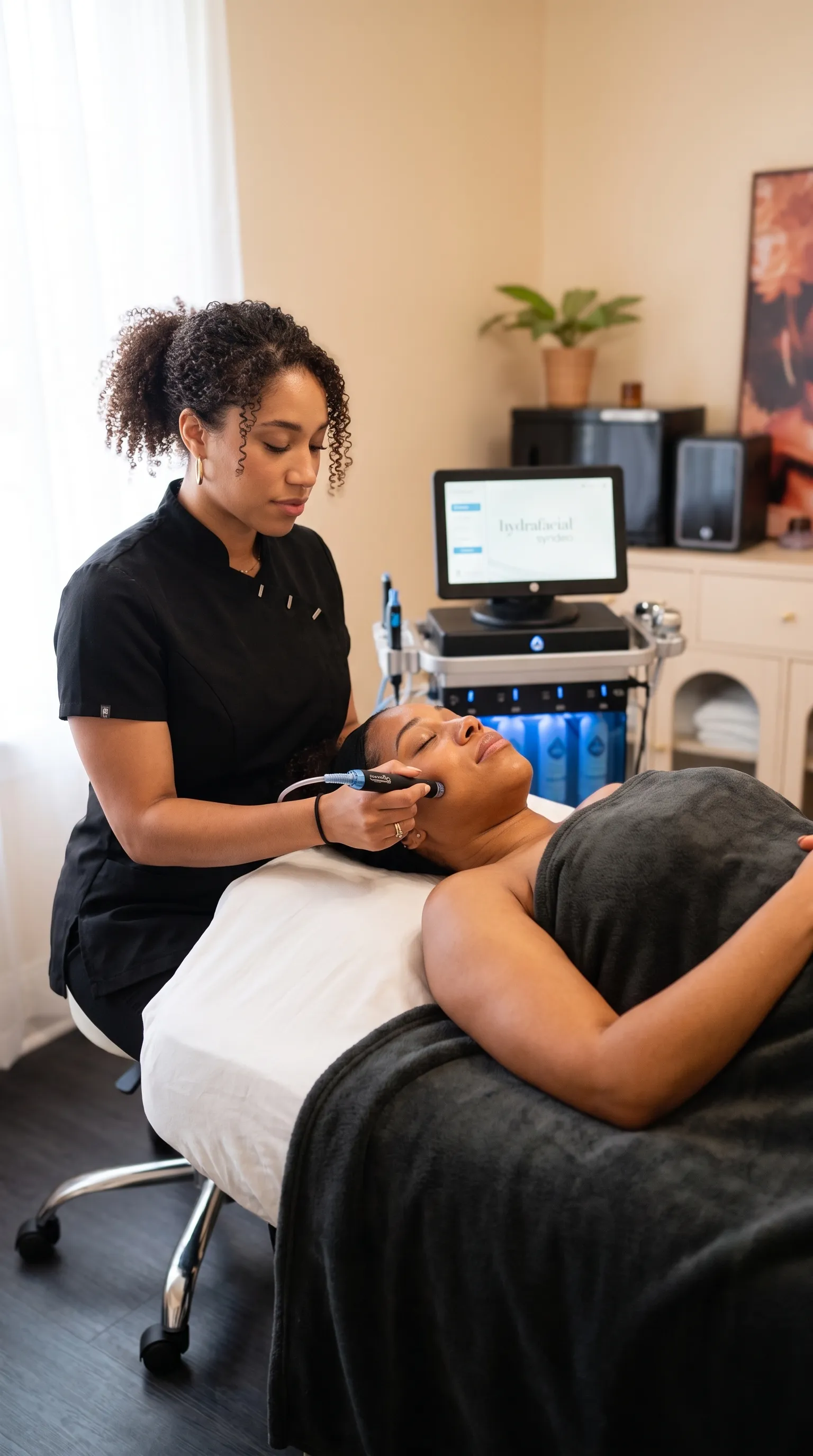
So for a North Park client whose breakouts are ongoing, the first move is usually not a peel. It is barrier and inflammation work: DMK enzyme therapy at $279 rebuilds the condition and function of the skin rather than resurfacing it, and HydraFacial at $259 clears congestion with vacuum-based extraction instead of the manual pressure that spreads inflammation and can rupture capillaries. Where the breakouts are being driven by something an esthetician cannot address, that is said plainly at the consultation rather than treated for months.
Once the inflammation has settled and the barrier is stable, the LIRA chemical peels become the instrument, at $199 for the Gentle Renewal formulation and $299 for the Advanced. The strength escalates across the series rather than inside a single visit, and the pace between sessions is set by how the skin actually responded to the last one.
What the consultation establishes
Three things, in this order. First, what the marks actually are — post-inflammatory, melasma, or sun damage — because they look alike from across the room and behave differently underneath. Second, whether the inflammation is still running, and if so, where it comes from: an active breakout pattern, a shaving or hair-removal irritation, a product reaction, or a routine that is simply too strong for the skin. Third, the condition of the barrier, because pigmentation does not exist independently of the rest of the skin.
The depth read matters as much as the identification. Pigment sitting in the surface layer and pigment that has descended into the mid-layers are reached differently and fade on different timelines, and it is the read that decides whether the correction is peels alone or peels with Procell microchanneling at $475 layered in — $1,199 for a series of three, working mechanically with no heat or light for skin that reacts to both.
A fourth thing is asked about and rarely volunteered: what the client is already doing. A routine that is too strong, an exfoliating acid used daily, a sunscreen that is applied rarely rather than properly, or a product that was changed three times in a month — all of it changes how the skin will respond to a correction. Kiki would rather change the routine before changing the skin, because a plan built around a habit that is damaging the barrier is a plan that will stall.
What a ten-minute drive changes
North Park is the only area served where no freeway is involved. From the intersection of 30th and University, head west on University Avenue through Hillcrest, bear left where it meets Washington Street, and take the first left onto Reynard Way. Three and a half miles, about ten minutes off-peak, with the freeway passing underneath and no merge to negotiate. The studio is at 3067 Reynard Way in Mission Hills, with free parking on site and the door opening onto a single treatment room.
Ten minutes is not a travel detail here. It is what makes a biweekly schedule possible, and a biweekly schedule is what a corrective course requires: peels are spaced far enough apart for the barrier to recover, and a client who has to build a special trip out of a working day will simply not make the third one. It is also why the whole course is booked as a block at the first appointment — the appointments sit around recovery rather than around convenience.
There is a second consequence of the proximity, and it is about consistency rather than convenience. The practitioner who reads the marks at the first visit is the one who performs the third. Nothing has to be re-explained between sessions, no protocol restarts because a different person is in the room, and no part of the plan is renegotiated each week. For a client whose marks arrived gradually over years, that continuity is what makes the correction legible.
The walk is 65 to 75 minutes via University and Washington, and the Route 7 bus covers the route in roughly 20 minutes. Both are realistic options for maintenance appointments, with the usual caveat that the seven days after a peel ask for no direct sun, so the trip home is better scheduled after the light has softened or taken with a ride.
What North Park clients should expect
The first visit is a consultation with a treatment on the same day, and the treatment is chosen by what is found rather than by what was booked. A first-time consultation and treatment is $249.
The correction then runs on intervals, and the visible change is slower than a single facial would be. The first measurable change tends to arrive at around the two-week mark after the first peel, and the second and third sessions are where the compounding happens. The expectation is reduction rather than elimination: melanocytes keep the capacity to produce pigment, and what is being managed is how enthusiastically they respond to inflammation. On a face that is still breaking out, part of the work is upstream of the pigment entirely, and that is why the plan does not start with a peel.
Every session is performed by Kiki, a California licensed esthetician with 7+ years of experience, in a one-room studio, by appointment only. Full directions and neighborhood context are on the North Park service area page, and an appointment can be requested online or by phone on (310) 595-0872.