Skip to content
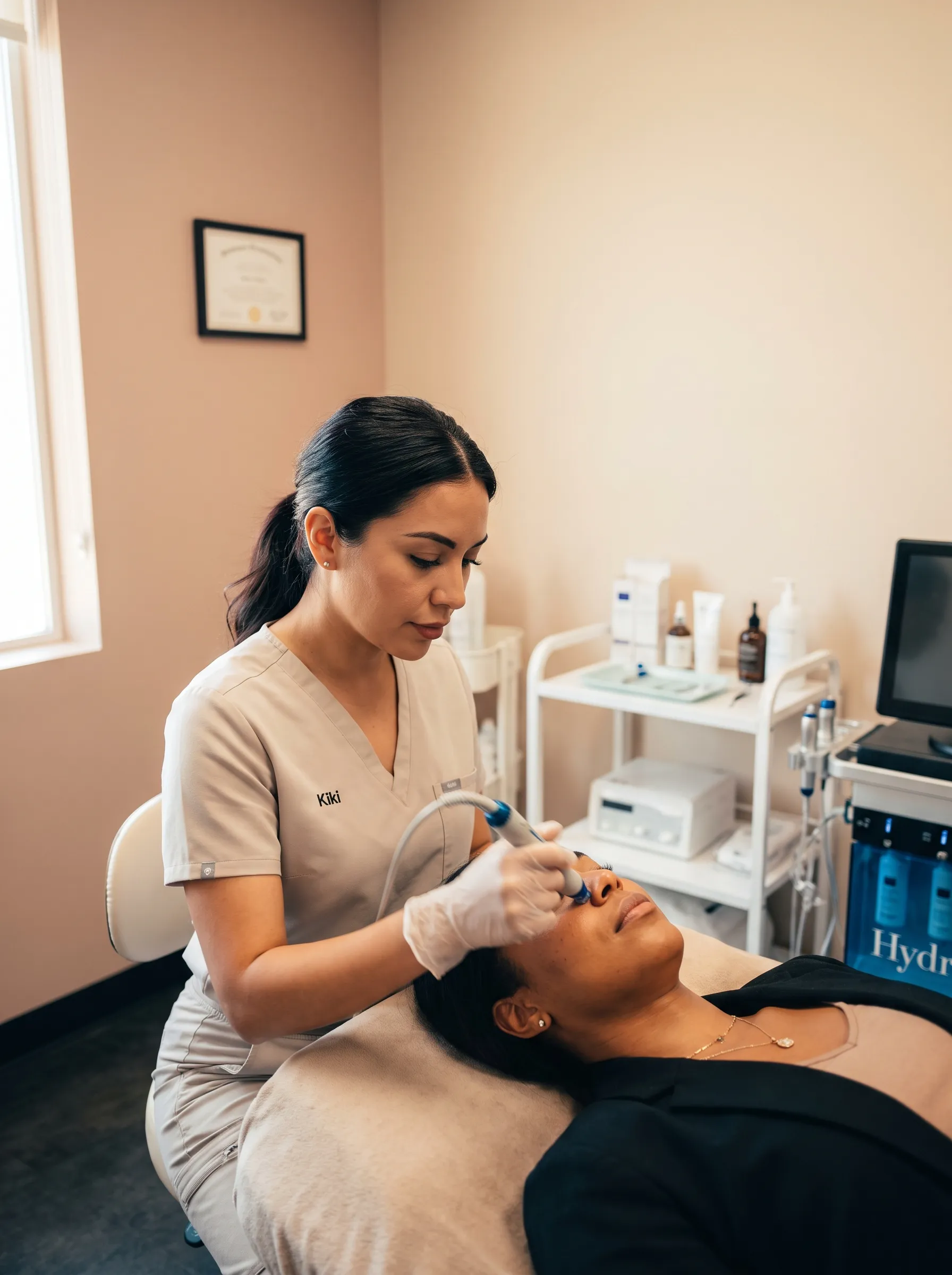
HydraFacial treatment for Point Loma clients

Point Loma, San Diego, CA

Hyperpigmentation Treatment in Point Loma, San Diego

Correction, with a barrier rebuilt underneath.

Pigment cannot be corrected on a barrier that is not holding, and a peninsula client often arrives with both problems at once. KIAMO Skin treats the barrier first, then corrects the mark with peels, microchanneling and brightening HydraFacials. The plan and its price are set at the consultation, and the studio is twelve minutes away.

LIRA Chemical Peels

$199–$299

  • By appointment only
  • Free parking
  • Consultations included — the plan is set before a booking is made
  • Calibrated for every Fitzpatrick type
  • SPF with iron oxides built into the plan
  • Addresses the source, not just the mark
  • Peels from $199, microchanneling $475

About KIAMO Skin

Last updated 21 November 2026

  • KIAMO Skin performs every treatment in one private treatment room at 3067 Reynard Way in Mission Hills, San Diego.
  • KIAMO Skin is a licensed facial spa. Kiki, a California licensed esthetician with 7+ years in corrective skin work, performs every treatment personally.
  • KIAMO Skin publishes every price before a booking is made — the first visit is $249, and a HydraFacial is $259.
  • KIAMO Skin treats every Fitzpatrick type from I to VI, and raises peel strength only as the barrier allows.
  • KIAMO Skin is by appointment only, with free parking on site and free cancellation up to 48 hours before.
  • Licensed esthetician — California Board of Barbering & CosmetologyKiki performs every treatment, in a one-to-one private studio in San Diego.
  • 7+ years of corrective skin workAdvanced training in HydraFacial Syndeo, Procell microchanneling, DMK enzyme therapy, and LIRA Clinical peels.
  • Prices published before a booking is madeNothing is quoted at the door, and the first visit includes the consultation that decides the plan.

Rated 5 out of 5 stars. — 42 five-star Google reviews

Verified on 2026-11-19 · Independent of KIAMO Skin

“Worth every penny. My skin has never looked better.”
— Jessica L., Yelp · Point Loma
“My skin was glowing when I left!”
— Leigh B., Yelp · Point Loma

Every Google review of KIAMO Skin is published in full, named and dated, at the reviews page.

Quick Answer

KIAMO Skin corrects dark marks and uneven tone for Point Loma clients at a one-room facial spa in Mission Hills, about twelve minutes east via Rosecrans Street and Washington Street, with free parking on site. Kiki, a California licensed esthetician with 7+ years, treats marks with LIRA chemical peels from $199, Procell microchanneling at $475 and HydraFacial at $259, calibrated to the Fitzpatrick type. On this peninsula the marks usually come from several causes at once — old inflammation, salt air, wind and decades of sun — so they are separated before anything is applied rather than treated as one undifferentiated stain.

The approach

Why Point Loma clients need the marks separated before they are treated

The most common reason a correction stalls is that two different conditions were treated as one. On Point Loma that risk is higher than anywhere else in the areas served, because the marks are usually a mixture: something left behind by an old inflammation, something the sun has been doing for fifty years, and a barrier that the salt air and the wind have been working on the whole time. Kiki has 7+ years treating pigmentation across every Fitzpatrick type, and the single-practitioner model means the person who reads the pattern at the first visit performs every session and raises the strength only as the skin allows.

The local concern

What a decade of salt air does to a skin barrier

Point Loma has water on both sides, and the skin pays for it in a way inland neighbourhoods never do. The Pacific side brings salt spray and year-round wind; the bay side brings reflected UV off the water at midday. Wind is the underrated one — it strips the lipids that hold the barrier together, and the skin that has been buffeted for years is the skin that reacts to a product it used to tolerate. That is why the barrier work usually comes first here, and why a peel before the skin is ready does more harm than good.

Landmarks in Point Loma

  • Liberty Station
  • Ocean Beach
  • Sunset Cliffs
  • Cabrillo National Monument
  • Point Loma Lighthouse
  • Shelter Island
  • Fort Rosecrans National Cemetery
  • Point Loma Nazarene University

What sets it apart

What a Point Loma hyperpigmentation plan actually does

The plan starts by sorting the marks, then works from the condition of the skin outward:

  • Each mark identified by cause — old post-inflammatory marks, sun-damage fields, or a mix of both
  • The barrier assessed first, because salt air and peninsula wind strip the lipids that hold it together
  • A LIRA peel strength selected for the skin tone and escalated only across the series
  • Procell microchanneling considered where the pigment has descended with age, because a peel alone will not reach it
  • Mineral SPF with iron oxides prescribed daily, so the correction is not undone by the next clear afternoon

The process

How a dark-mark correction runs at KIAMO Skin

Three steps, in this order. Identifying what the mark actually is decides the instrument, assessing the condition of the skin decides whether that instrument is safe yet, and spacing the corrections decides whether they hold. On a peninsula with wind and salt on both sides, the second step carries more weight here than on a sheltered inland face.

  1. 01

    Identify the mark

    Post-inflammatory marks, melasma and sun damage look alike on the surface and behave differently underneath, and choosing the wrong approach is the most common reason a correction fails. A Point Loma client often arrives with a single dark patch from an old shaving nick or an acne episode from decades ago, sitting on a broader field of sun-driven uneven tone across the forehead and cheekbones. One is a mark. The other is a field. They respond to different depths, and treating them with one instrument is what produces a flat, disappointing result.

  2. 02

    Assess the skin

    Pigmentation does not exist independently of the rest of the skin, and this peninsula is hard on the barrier in a specific way: wind removes what salt water has already loosened, and there is not a day of the year when both are absent. The assessment reads barrier condition, congestion, and how reactive the skin is to what is already in use. Skin that has been in the sun for decades is also thinner and more reactive than it was, and a treatment chosen for a twenty-five-year-old face can be wrong for this one.

  3. 03

    Correct, then hold it

    An appropriate treatment is selected and spaced far enough apart for the skin to recover, and then daily SPF does the holding — because a new mark keeps arriving if the inflammation does. For an older, long-exposed client the daily layer matters most of all, because the ultraviolet that produced the existing marks is still arriving and the melanocytes still respond to it as enthusiastically as they always did.

What a decade on the peninsula does to a face

Point Loma is a peninsula, and clients come from both of its coastlines — Ocean Beach and Sunset Cliffs on the Pacific side, Shelter Island and Harbor Island across the bay. The Pacific side brings salt spray and year-round wind off the water. The bay side brings reflected ultraviolet light at midday, off a surface that is doing the same reflecting job the sand does at the beach. The wind is the underrated one. It strips the lipids that hold the barrier together, and skin that has been buffeted for years is skin that reacts to a product it used to tolerate.

The population matters as much as the climate. The neighborhoods around Rosecrans Street and the western tip are working, maritime and long-sun-exposed, and many of the clients who come to the studio are people who have been outdoors in this microclimate for decades rather than seasons. What that produces is not a single condition but an accumulation: a face with a history of ordinary skin injuries — a shaving nick, an ingrown hair, an acne episode that was never treated — each of which left a mark, sitting under a broad field of sun-driven uneven tone that accumulated slowly over the same period.

The result is what the service description calls uneven tone across the face with no single cause. It looks like one problem and it behaves like three, and that is the reason the first appointment here is not a peel. It is a sorting.

Why the marks have no single cause

Post-inflammatory hyperpigmentation is the skin's response to inflammation. It sits where the injury was, in the surface and mid-layers, and it runs deeper and lasts longer on melanin-rich skin, where melanin is produced readily in response to inflammation. That is the first kind of mark, and on Point Loma it is often the oldest and the most specific — a single dark patch, sharply localised, that has been there since an injury years ago.

The second is sun damage, and it does not behave like a mark at all. It is a field: uneven tone across the forehead, the cheekbones, the bridge of the nose and the ears, distributed by where the light actually lands. It is not one injury but several decades of the same exposure, and it responds to depth rather than to a spot.

The third is melasma — hormonal, and light-driven — which tends to arrive symmetrically across the upper lip, the cheeks and the forehead, often in later life as the hormonal picture shifts.

These three look alike from the doorway and behave differently underneath. A peel built for a spot applied across a field, or a peel built for a field applied to one stubborn mark, produces the flat, disappointing result that makes people say the treatment did not work. The three kinds of dark mark is the shortest useful read on the subject, and it is worth ten minutes before the first appointment.

The barrier comes first on this peninsula

The barrier work usually comes before the pigment work here, and the reason is the climate rather than the age of the client. Salt air and peninsula wind work together: the salt loosens the surface lipids and the wind takes what is left, and the rinse afterwards removes the oils that hold the barrier together. The result is skin that is tight by the afternoon, reactive to products it tolerated a year ago, and slow to settle after anything.

That state is not cosmetic. A peel is a controlled injury, and the inflammatory response it produces has to be resolvable by the skin it happened to. On a stripped barrier it often is not, and the pigment that follows is darker and more persistent than what was being treated. So the sequence usually starts with DMK enzyme therapy at $279, which rebuilds the condition and function of the skin rather than resurfacing it, and with HydraFacial at $259, which clears congestion with vacuum-based extraction rather than the manual pressure that spreads inflammation.

Once the barrier is holding, the LIRA chemical peels at $199 for the Gentle Renewal formulation and $299 for the Advanced become the instrument for the pigment, with the strength escalated across the series rather than inside one visit. Dermaplaning at $199 clears the surface buildup that stops a peel penetrating evenly, and it removes the fine facial hair that many clients find they have never had treated anywhere else.

What Procell is for, and when it is used

A peel reaches the surface and the upper mid-layers. Pigment that has descended further — which is what happens to a spot that has sat untreated for years, particularly on the deeper skin tones where the marks run deeper anyway — is not fully within its reach. Procell microchanneling at $475, or $1,199 for a series of three, is used where that is the case, and where the marks sit alongside texture or scarring.

It works mechanically. Sterile stamps create controlled micro-injuries at a calibrated depth, which triggers a collagen response, and there is no heat and no light involved — which matters on skin that reacts to both, and on skin that has been in the sun for forty years. It is also the reason some Point Loma clients arrive expecting one treatment and leave with a plan that has a peel component and a Procell component, sequenced rather than simultaneous.

The series itself is paced by the skin rather than by a fixed calendar, and the intervals tend to be wider here than they would be for a younger client on the same treatment. That is not caution for its own sake. The collagen response that Procell triggers is doing real work on skin that has had less of it for longer, and the time is part of the treatment rather than a delay before it.

Expectations for an older, long-exposed client

The timeline is longer, and it should be said plainly at the consultation rather than discovered halfway through. Skin that has carried decades of ultraviolet is thinner and more reactive, so the first peel is set lower and the intervals are wider. The visible change is slower to arrive and it compounds across the series rather than appearing at the second visit.

The expectation is reduction rather than elimination. Melanocytes retain the capacity to produce pigment for life, and the ultraviolet that produced the existing marks is still arriving — off the water on the bay side, off the sand on the Pacific side, and reflected off both. What is being managed is how enthusiastically the melanocytes respond, and how much the daily protection holds them in check. That last part is the daily layer: mineral SPF with iron oxides, every day, because visible light drives pigment on its own and a UV-only sunscreen does not block it.

There is also a realism worth offering. A field of sun damage across the forehead will never look the way it did at thirty, and a client who is told that at the first visit is a client who is not disappointed at the fourth.

Twelve minutes from the Rosecrans corridor

From Liberty Station, take Rosecrans Street east to Washington Street and turn left — about twelve minutes. From Ocean Beach and Sunset Cliffs, come in on Voltaire Street or Catalina Drive to the Rosecrans corridor and continue east. From Shelter Island and Harbor Island, take the Rosecrans Street off-ramp from I-5 north. The studio is at 3067 Reynard Way in Mission Hills, off Washington Street, with free parking on site.

That distance is the reason a corrective course is workable from the peninsula. A series spaced four to six weeks apart needs six or seven visits over several months, and a twelve-minute drive is the difference between a course that gets scheduled and one that quietly stops after the second appointment. The whole series is booked as a block at the first visit, so the appointments sit around recovery rather than around convenience.

The studio is one treatment room, by appointment only, so a space is always there when a client arrive and nobody else is in the room. Every session is performed by Kiki, a California licensed esthetician with 7+ years of experience. Full directions and neighborhood context are on the Point Loma service area page, and an appointment can be requested online or by phone on (310) 595-0872.

Who books this

Who books hyperpigmentation treatment in Point Loma

Point Loma clients most often book for uneven tone across the face that has no single cause, and for the specific dark marks that outlived the condition that produced them — a shaving nick from a working life, an acne episode, a spot that never quite went. Many are older clients who have spent decades in salt air and sun and have accepted the tone as permanent. Others come for sun damage around the eyes and across the forehead after a summer on the peninsula. KIAMO Skin fits when the priority is a plan that separates the marks before treating them, a peel selected for the skin tone, published pricing, and one practitioner for the length of the course — twelve minutes from the Rosecrans corridor.

KIAMO Skin pricing

Every price below is published before a booking is made. Nothing is quoted at the door, and the first visit includes the consultation that decides the plan.

Prices and protocols last reviewed 21 November 2026.

LIRA Chemical Peels
$199–$299
The standard first step. Strength is escalated across a series and the peel is selected for the skin tone, which is what keeps a correction from becoming a new mark.
Procell Microchanneling
$475
For marks that sit alongside texture or scarring. Works mechanically, with no heat or light — which matters on skin that reacts to both.
HydraFacial
$259
Cleansing, exfoliation, extraction, and hydration, with a brightening booster selected for the pigment. Usually the maintenance layer between corrections.
DMK Enzyme Therapy
$279
A different approach, centred on the condition and function of the skin. Considered when the barrier is compromised and a peel would be too much.
Dermaplaning
$199
Physical exfoliation that clears surface buildup and gives a smoother-feeling surface, which lets everything after it work better.

Each price above is for one treatment. The plan itself — which treatments, how many sessions, and how far apart — is set at consultation.

Quick Answer

Post-inflammatory hyperpigmentation treatment at KIAMO Skin targets the dark marks acne, eczema, ingrown hairs, and injury leave behind. Kiki is a California licensed esthetician with 7+ years of experience, and protocols are calibrated for every Fitzpatrick type from I to VI — including melanin-rich skin, where an incorrect peel causes more damage than it repairs.

A published case

Dark marks left by acne and shaving, cleared across a series on melanin-rich skin with daily tinted SPF between visits.

Treatment
Lira Chemical Peels
Sessions
4
Over
Over 5 months

Every figure is the studio's own record from that case, photographed with written consent and published in full. See the full case

Before a client commits to KIAMO Skin

The price comes first

Every treatment price is published on the menu. Nothing is quoted at the door, and the first visit includes the consultation that decides the plan.

Nothing is treated before it is assessed

A full consultation and skin analysis come first, and the treatment is chosen around what the skin is doing that day.

A stated cancellation window

Please give 48 hours notice to reschedule. Cancellations inside 24 hours are charged 50% of the service; no-shows are charged in full.

Every Google review of the studio is published in full, named and dated, at the reviews page.

Before a booking is made

Point Loma questions, answered

Why do Point Loma clients arrive with marks of no single cause?
Because a lifetime on the peninsula stacks causes rather than replacing them. A shaving nick from a working life leaves one dark patch that never fully fades. An acne episode in a younger decade leaves a set of marks elsewhere. Over both, decades of sun across the forehead, the cheekbones and the ears add a broader field of uneven tone. The result looks like one stain and behaves like three, and treating it as a single mark is why some clients see the upper lip clear while the cheekbones look exactly as before. KIAMO Skin performs every treatment in one private treatment room, by one licensed esthetician, with the plan written down before the next appointment is booked.
Is a peel safe on sun-damaged skin in a client in their sixties or seventies?
It can be, but the starting point has to be lower and the pace slower than for a younger face. Skin that has carried decades of ultraviolet is thinner and more reactive, and the inflammatory response a peel produces is less comfortably resolved. Kiki reads the barrier and the depth of the pigment at the first visit and sets the first peel accordingly, then escalates only on how the last one behaved. Where the pigment has descended with age, a peel alone will not reach it and Procell microchanneling is considered alongside it. KIAMO Skin runs every treatment on the tone in front of the practitioner, because heat and aggressive treatment are what deepen pigment on the skin that marks most easily.
What does a correction cost when the plan combines peels with Procell?
It depends on which parts of the plan the skin needs, and that is worked out at the consultation. LIRA chemical peels are $199 for the Gentle Renewal formulation and $299 for the Advanced. Procell microchanneling is $475 per session, or $1,199 for a series of three, and it is the component that reaches pigment which has descended with age. A HydraFacial is $259, DMK Enzyme Therapy Level 1 is $279, and dermaplaning is $199. A first-time consultation and treatment is $249, and the total is confirmed before anything is booked. At KIAMO Skin every price is published before a booking is made — a LIRA peel from $199, and the first visit with the consultation and skin analysis is $249.
How does the wind on the peninsula change the plan?
It is usually the reason the barrier work comes first. Wind removes the surface lipids that salt water has already loosened, so the skin here is tight and reactive, and it stops tolerating products it handled a year ago. A peel applied to a barrier in that state produces an inflammatory response the skin cannot resolve cleanly, and inflammation is what creates pigment. DMK enzyme therapy rebuilds the condition and function of the skin, a HydraFacial keeps it hydrated between sessions, and the peel series waits until the skin can hold the inflammation down. KIAMO Skin performs every treatment in one private treatment room, by one licensed esthetician, with the plan written down before the next appointment is booked.
Is twelve minutes from the Rosecrans corridor worth the trip?
It is a short drive and it is the reason a series gets finished. From Liberty Station, Rosecrans Street east reaches Washington Street in about twelve minutes. From Ocean Beach and Sunset Cliffs, come in on Voltaire Street or Catalina Drive to the Rosecrans corridor. From Shelter Island and Harbor Island, take the Rosecrans off-ramp from I-5 north. The studio is at 3067 Reynard Way in Mission Hills with free parking on site, one treatment room, by appointment only, and every session is performed by the same practitioner from the first visit to the last. KIAMO Skin performs every treatment in one private treatment room, by one licensed esthetician, with the plan written down before the next appointment is booked.

A question the answers above do not cover? Ask KIAMO Skin.

3067 Reynard Way
San Diego, CA 92103

Off Washington Street — minutes from Hillcrest, Bankers Hill and Little Italy.

(310) 595-0872

kiamoskin@gmail.com

By appointment only · Free parking

Start here

Hyperpigmentation Treatment in Point Loma — with the price before a booking is made.

First visit

$249

A consultation, a skin analysis and the first treatment, in one visit. Nothing is treated before it has been looked at, and nothing is quoted at the door.

Or start with the series

Correction runs across a series, not a single visit. A monthly plan keeps the schedule on track and costs less than booking the same treatments one at a time — from $199 a month.

Compare monthly facial memberships in San Diego

Ask before the first visit

Not sure which treatment fits, or what it would take? Send the question. It goes straight to the studio, and the reply comes from the person who would be doing the work.

No obligation. Or call (310) 595-0872 to talk it through.

Request AppointmentCall the studio at (310) 595-0872